







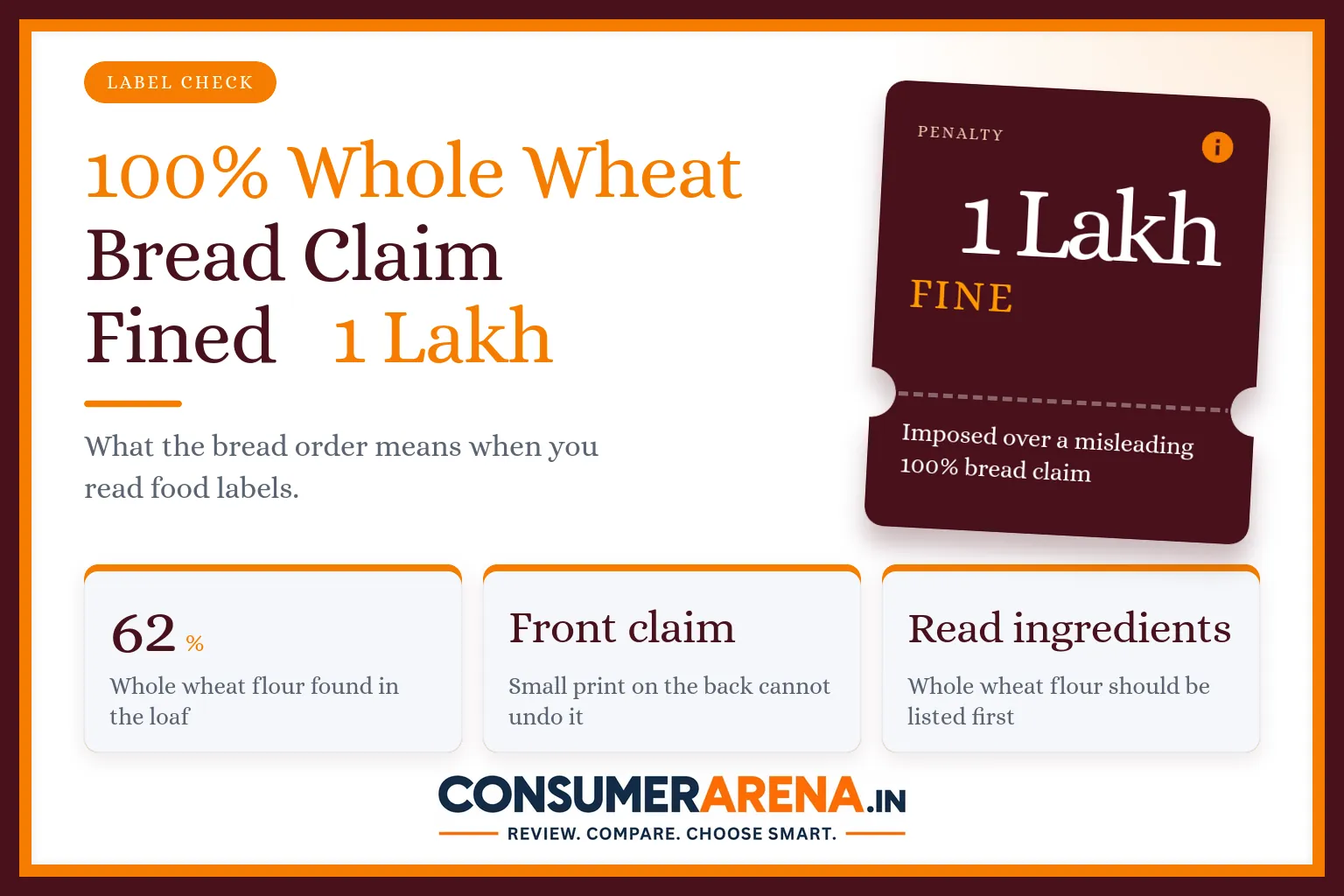
You pick up a loaf that says “100% Whole Wheat” and “0% Maida” on the front. It feels like the healthy choice. But what if the bread inside is not fully whole wheat at all? The Central Consumer Protection Authority (CCPA) has now fined Britannia ₹1 lakh over exactly this kind of claim on its bread.
What Happened With the 100% Whole Wheat Bread Claim?
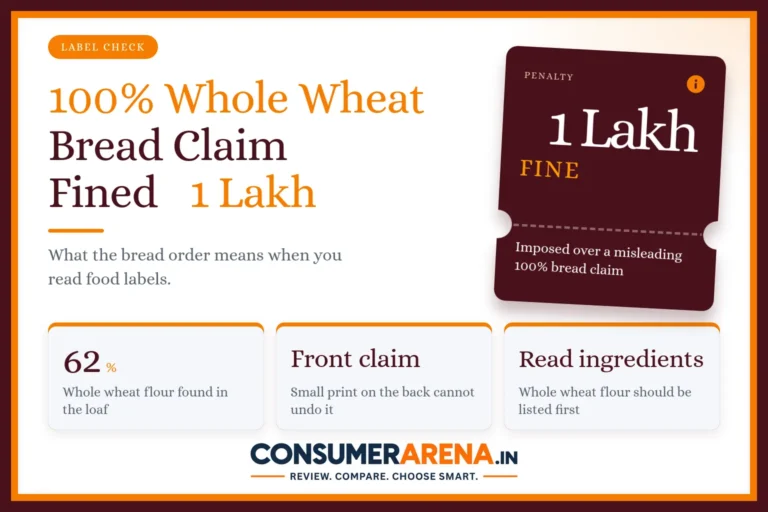
The CCPA looked into a Britannia bread sold as “100% Whole Wheat Bread”, with a “0% Maida” line beside it. Its check found that the loaf contained 62% whole wheat flour. The rest was water, yeast, wheat bran and other ingredients.
The authority treated the claim as misleading and imposed a penalty of ₹1 lakh. The bread carried a line on the back of the pack saying it was made from 100% whole wheat flour on a “flour basis”. The CCPA found that this small print did not undo the impression created by the large claim on the front.
This is not the first such case this year. The CCPA has earlier fined other food companies ₹1 lakh each for “100%” claims on their products.
Why This Matters to You
Most of us decide in a few seconds in the shop aisle. We read the big words on the front and move on. A claim such as “100%” tells you the product is complete, pure or nothing but the named ingredient. If the loaf is only 62% whole wheat flour, you are paying a premium price for something different from what you were promised.
The rest of the bread is not necessarily harmful. Water and yeast are normal in bread. The issue is honesty: the front of the pack should give a fair picture of what is inside, without you having to hunt through small print.
What “0% Maida” Does and Does Not Tell You
Maida is refined white flour. “0% Maida” says the bread has no refined flour. That can be true even when the loaf is not all whole wheat, because other ingredients may still make up part of it. So “0% Maida” and “100% whole wheat” are two different promises, and one does not prove the other.
How to Read a Bread Label in 30 Seconds
You do not need any special knowledge. Turn the pack around and check these things:
- The ingredient list. Ingredients are listed from the largest amount to the smallest. For a genuine whole wheat loaf, whole wheat flour should come first.
- The percentage. Some packs state how much whole wheat flour they contain. Compare that number with the claim on the front.
- The small print. If the back says “on a flour basis” or something similar, the claim may cover only part of the product.
- The words used. “Multigrain”, “brown” and “atta” do not automatically mean whole wheat. Brown colour can come from added colouring.
- The price. A higher price for “whole wheat” is only worth paying if the ingredients match the claim.
What You Can Do If a Label Misleads You
If you feel a pack or advertisement is misleading, keep the pack or take clear photos of the front, the ingredient list and the batch details. Then you can call the National Consumer Helpline on 1915 or file a complaint online through the consumer complaint portal. Even when no single complaint leads to a big penalty, a pattern of complaints helps the authority spot repeated misleading claims.
Frequently Asked Questions
Is Britannia bread unsafe to eat after this order?
The order is about a misleading claim, not about safety. The authority fined the company for how the bread was described, not for any health risk.
What does 100% whole wheat bread actually mean?
It should mean that the flour used is whole wheat flour only. If a pack says 100% but the ingredient list shows other flours or a lower share of whole wheat flour, the claim may be misleading.
Does 0% Maida mean the bread is whole wheat?
No. It only says that there is no refined flour in it. A loaf can have no maida and still not be fully whole wheat.
Can small print on the back of the pack correct a big claim on the front?
The CCPA held in this case that it cannot. The front claim is what most buyers see first, so it has to be fair on its own.
Where can I complain about a misleading food label?
You can call the National Consumer Helpline on 1915 or file a complaint on the consumer complaint portal. Keep photos of the pack and your bill ready.
Related articles
 FoodWarning Labels on Packaged Food: What the Supreme Court Case Means for You22 Oct 2026
 FoodMicroplastics Warning on Bottled Water, Sugar and Salt: What the Madras High Court Order Means for You21 Oct 2026
 FoodMisleading Food Labels: What FSSAI’s Action on “100% Natural” Claims Means for You12 Oct 2026
 FoodDiwali Sweets Safety: What the FSSAI Festive Drive Means and What to Check Before You Buy10 Oct 2026