






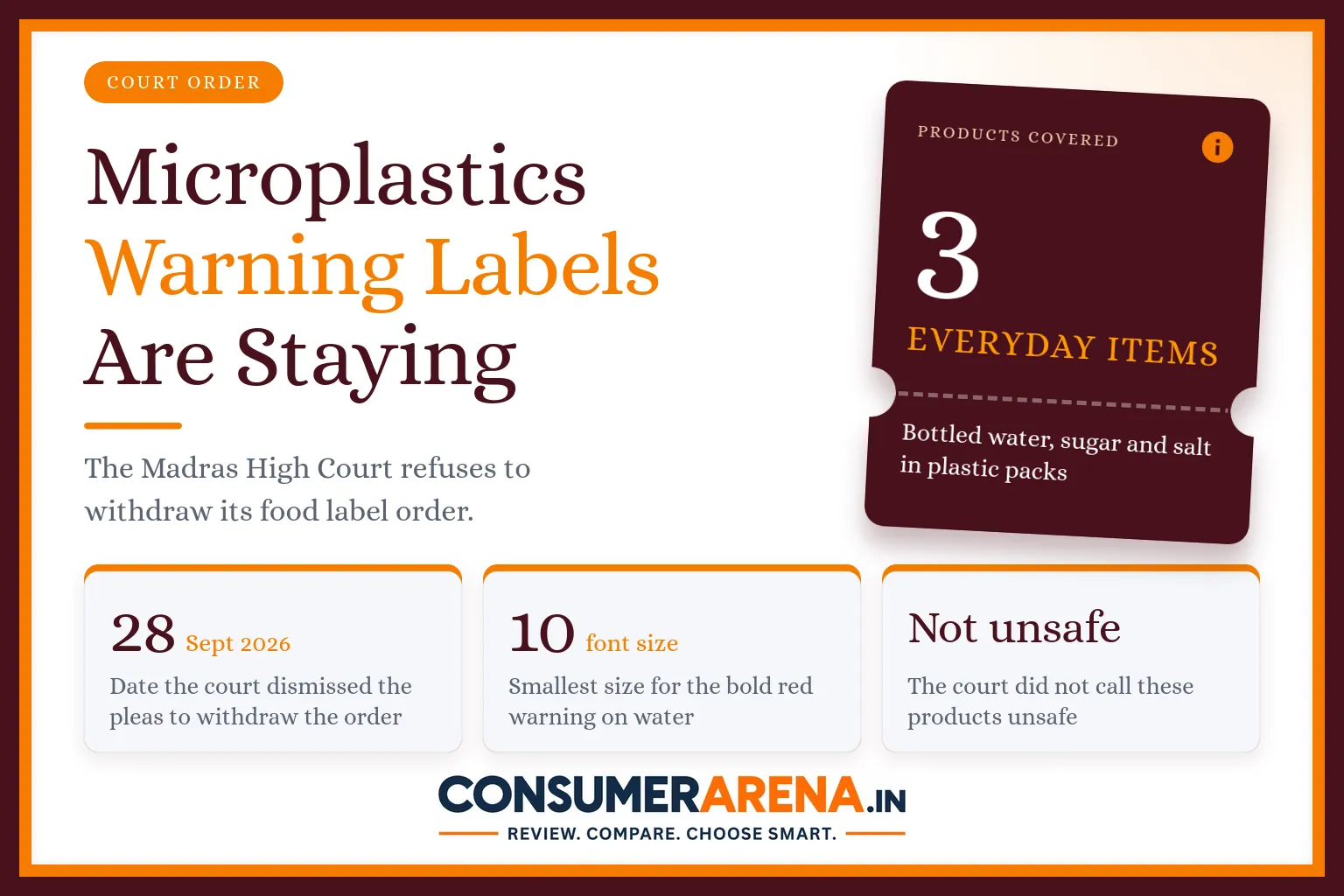
Next time you pick up a bottle of water or a packet of salt, you may find a new line on the label saying the product “may contain micro/nano plastics”. The Madras High Court has refused to withdraw its order on microplastics label warnings for packaged drinking water, sugar and salt, so the requirement stays in place for now.
What Has the Court Ordered?
In February 2026, the court passed an interim order on food labels. Drinking water sold in plastic or PET bottles must carry the line “This water may contain Micro/Nano Plastics”, printed in bold red letters of at least font size 10. Sugar and salt sold in plastic packaging need a similar warning. The food safety regulator, FSSAI, was told to inform manufacturers and make sure the order is followed.
The regulator itself, along with industry groups for packaged-water makers and bottle makers, asked the court to change or withdraw the order. On 28 September 2026 the court dismissed those pleas. The order is still interim, which means the case continues and all sides can be heard again.
Does This Mean These Products Are Unsafe?
No. The court was careful on this point. It did not declare bottled water, sugar or salt unsafe. The order asks only for disclosure, so that you can decide for yourself while studies on the health effects carry on.
The makers argued that nobody has proved harm yet, and that a warning could frighten people. The court answered that being unsure about the science is not a reason to keep buyers in the dark. It called the label the barest minimum of disclosure. Nothing in the order tells you to stop using these products.
What Are Microplastics?
Microplastics are tiny bits of plastic, generally smaller than five millimetres. Nanoplastics are smaller still, too small to see. They can come from many places, including the water source, the bottle or the packet itself.
The makers said microplastics may already be in the water before it is bottled. The court did not accept that as a reason to stay silent. Wherever the particles come from, it said, the buyer should be told that they may be present.
Why the Court Wants Buyers to Know
The court treated this as a question of informed choice. Many Indians rely on bottled water every day, and sugar and salt are in nearly every kitchen. If there is a possible risk, even one that is still being studied, the court felt people should have the information to decide for themselves.
The court also did not agree that India should simply wait because other countries have no such labels. It said the concern is serious for India given how widely packaged water is used.
What This Means for You
- You may soon see the new warning on bottled water and on sugar and salt sold in plastic packs. It is not yet clear when labels will reach the shelves in every shop.
- The warning says the product “may” contain microplastics. It does not tell you how much, and it does not say the product is harmful.
- The order covers water in plastic or PET bottles and sugar and salt in plastic packaging. It does not say anything about other kinds of packaging.
- Because the case is still going on, the details could change after further hearings.
A sensible approach is simply to read the label, the way you already check dates and ingredients. A warning is information, not an alarm. If you have specific health worries, a doctor is the right person to ask.
Frequently Asked Questions
Which products need the microplastics label?
Drinking water sold in plastic or PET bottles, and sugar and salt sold in plastic packaging. The water label must say that it may contain micro/nano plastics, in bold red letters.
Has the court said bottled water, sugar or salt is unsafe?
No. The court said it was not declaring these products unsafe. It only wants buyers to be told that microplastics may be present, while studies on health effects continue.
What are micro and nano plastics?
They are very small pieces of plastic. Microplastics are generally smaller than five millimetres, and nanoplastics are even smaller, too tiny to see with the eye.
Why did the court refuse to withdraw its order?
The court said scientific doubt is no reason to hide a possible risk from buyers. It found that the label is the least that could be asked and does not raise a false alarm.
Should I stop buying bottled water, sugar or salt?
The order does not say so. It asks for a label, not for a ban or a recall. The health effects are still being studied, so speak to a doctor if you have a specific worry.
Related articles
 FoodMisleading Food Labels: What FSSAI’s Action on “100% Natural” Claims Means for You12 Oct 2026
 FoodDiwali Sweets Safety: What the FSSAI Festive Drive Means and What to Check Before You Buy10 Oct 2026
 FoodWarning Labels on Packaged Food: What the Supreme Court Case Means for You22 Oct 2026
 FoodCentre Cuts Customs Duty on Edible Oils: What It Means for Consumers24 Sep 2026