







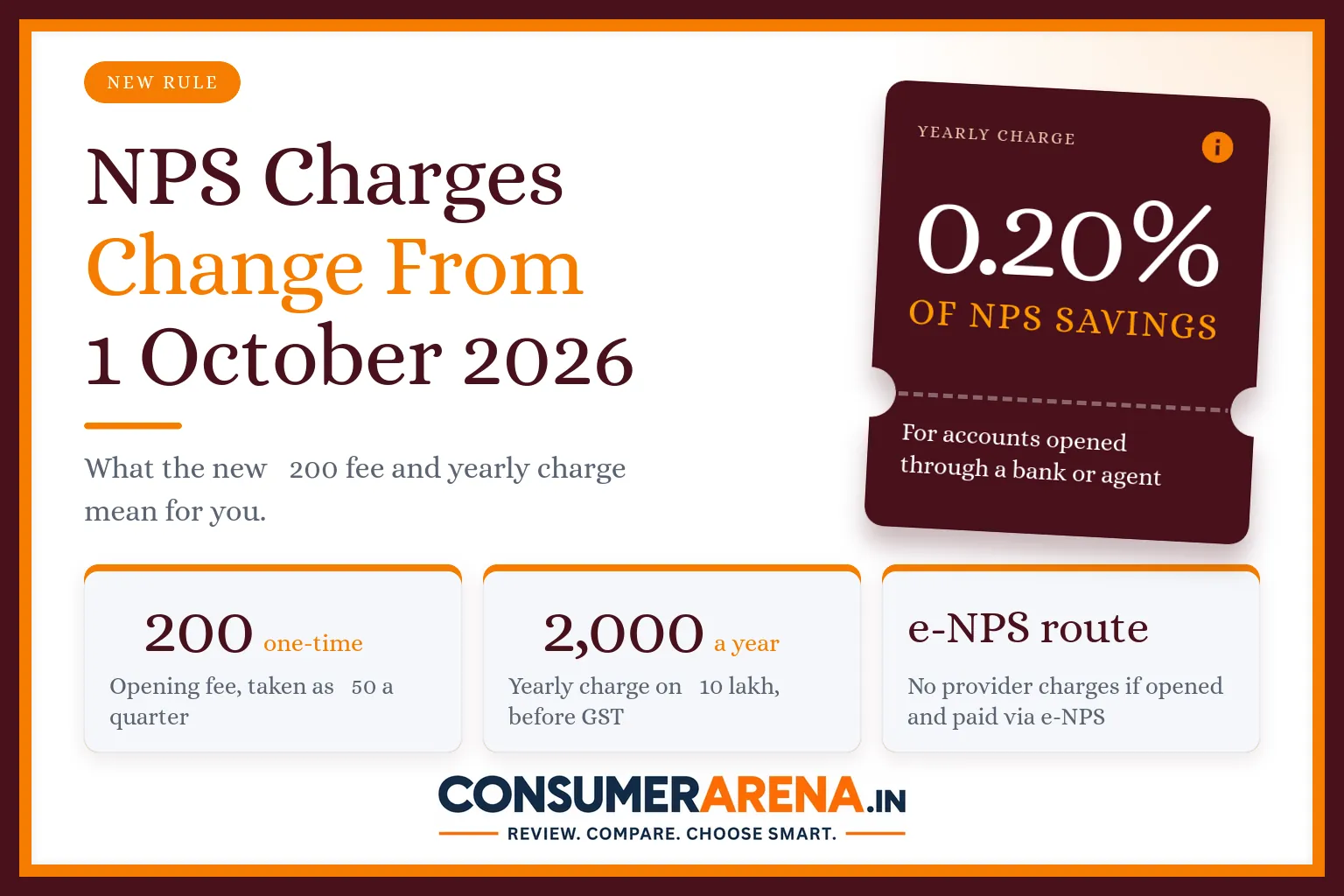
If you save for retirement through the National Pension System (NPS), you may not have paid much attention to the small fees in the background. That changes now. From 1 October 2026, new NPS charges apply to accounts opened through a bank or an agent, including a one-time fee of ₹200 and a yearly charge of 0.20% on your savings.
The amounts look small, but the yearly charge grows as your savings grow. Here is what has changed, who pays, and how the money is taken.
What Has Changed in NPS Charges?
Most people open an NPS account through a bank, a post office or another approved agent. In NPS language, such a service provider is called a Point of Presence. The pension regulator has now set one common fee structure for these providers, covering all schemes under NPS and NPS Lite.
Under the new rules, an account opened through such a provider carries:
- A one-time opening fee of ₹200 for each NPS account.
- A lower one-time fee of ₹100 that may apply when the provider opens the account fully online, without meeting you in person.
- A yearly charge of 0.20% on the total value of your NPS savings.
- GST and other taxes, added on top of these charges.
The fee is now the same whichever scheme or fund choice you have picked inside NPS. A few special schemes keep their own separate charge rules.
How Will the Money Be Taken?
You will not get a bill, and you will not need to pay anything in cash. The charges come out of your NPS account itself.
The ₹200 opening fee is split into four parts of ₹50. One part is taken each quarter by cancelling units worth ₹50 from your NPS holdings, until the full ₹200 is recovered. So your unit count drops slightly for one year.
The 0.20% yearly charge works differently. It is adjusted in the daily unit price of your fund, called the NAV, and paid to the provider every quarter. You will not see it as a separate line in your statement. Instead, it slightly lowers the value of your holdings over time.
The new deductions begin from the October to December 2026 quarter.
How Much Could You Pay Each Year?
Because the yearly charge is a percentage, it rises with the size of your savings. Before taxes, it works out roughly like this:
- ₹5 lakh in NPS: about ₹1,000 a year
- ₹10 lakh in NPS: about ₹2,000 a year
- ₹25 lakh in NPS: about ₹5,000 a year
- ₹50 lakh in NPS: about ₹10,000 a year
- ₹1 crore in NPS: about ₹20,000 a year
For someone who has just started, the amount is tiny. For someone with many years of savings, it becomes a noticeable sum, and it is charged every year until retirement. GST is added to these figures.
Who Does Not Pay These Charges?
Not every NPS member is affected in the same way. What matters is how your account was first opened.
Accounts opened online through e-NPS
If you opened your account yourself on the official e-NPS website, and you pay your contributions through e-NPS or by direct bank transfer into NPS (known as D-Remit), these provider charges do not apply to you. There is no bank or agent in between, so there is no one to pay.
Accounts with no recent contributions
An account counts as dormant when no money has gone into it for four quarters in a row, after earlier contributions. Dormant accounts are not charged. This is checked at the end of every quarter, and it looks at your PAN across all NPS record keepers.
A common misunderstanding
If your account was opened through a bank or agent, simply paying your future contributions through e-NPS or D-Remit does not remove the charges. The rule follows the way the account was opened, not the way you pay into it later.
Why This Matters to You
NPS is a long-term product. Many people stay in it for 20 or 30 years. Small charges that repeat every year add up over such a long period, and they reduce the final amount you take home at retirement.
The good news is that the structure is now simpler and the same everywhere. Providers must also show their updated charges clearly on their websites, and display them as a pop-up when you open an account online. That makes it easier to know what you are paying before you sign up.
What You Can Do Right Now
- Find out how your account was opened. Check your welcome letter or account details to see whether it was opened through a bank, an agent or e-NPS.
- Read your provider’s charge list. Your bank or agent must now show its NPS charges on its website.
- Watch your statement. In the coming quarters, look for small unit cancellations of ₹50 linked to the opening fee.
- Compare routes before opening a new account. If you or a family member plan to join NPS, check the charges for the bank or agent route and for e-NPS, and choose with full information.
- Ask questions before you sign. If someone offers to open an NPS account for you, ask clearly what fees apply and how they are collected.
The minimum contribution stays easy to manage: ₹250 when you open an NPS account and ₹10 for each later payment. Knowing the charges simply helps you see the true cost of your retirement savings.
Frequently Asked Questions
Who has to pay the new NPS charges from 1 October 2026?
The new charges apply to NPS accounts opened through a bank, post office or other approved agent. You pay a one-time opening fee of ₹200 and a yearly charge of 0.20% on your NPS savings, plus GST. Accounts opened yourself through e-NPS, with contributions paid through e-NPS or D-Remit, do not pay these charges.
How is the ₹200 NPS opening fee collected?
It is not paid in cash. The fee is split into four parts of ₹50, and units worth ₹50 are cancelled from your NPS holdings each quarter until the full ₹200 is recovered.
Will I see the 0.20% yearly charge in my NPS statement?
Not as a separate line. The charge is adjusted in the daily unit price of your fund and paid to the provider every quarter, so it slowly lowers the value of your holdings instead of appearing as a deduction.
If I start paying through e-NPS, will the charges stop?
No. If your account was opened through a bank or agent, the charges still apply even if you later pay through e-NPS or D-Remit. What matters is how the account was first opened.
Are inactive NPS accounts charged?
No. If no money has gone into your NPS account for four quarters in a row after earlier contributions, the account counts as dormant, and these provider charges are not applied to it.
Related articles
 Financial educationSBI ATM Charges From 1 October 2026: Free Limit Cut for Salary and Basic Savings Accounts12 Oct 2026
 Financial educationRBI Raises Repo Rate to 5.50%: What It Means for Your Home Loan EMI and Fixed Deposits12 Oct 2026
 Financial educationRBI Fraud Compensation From 1 January 2027: How You Can Get Up to ₹25,000 Back15 Oct 2026
 Financial educationEPF Wage Ceiling Raised to ₹25,000: What It Means for Your Salary, PF and Pension16 Oct 2026