
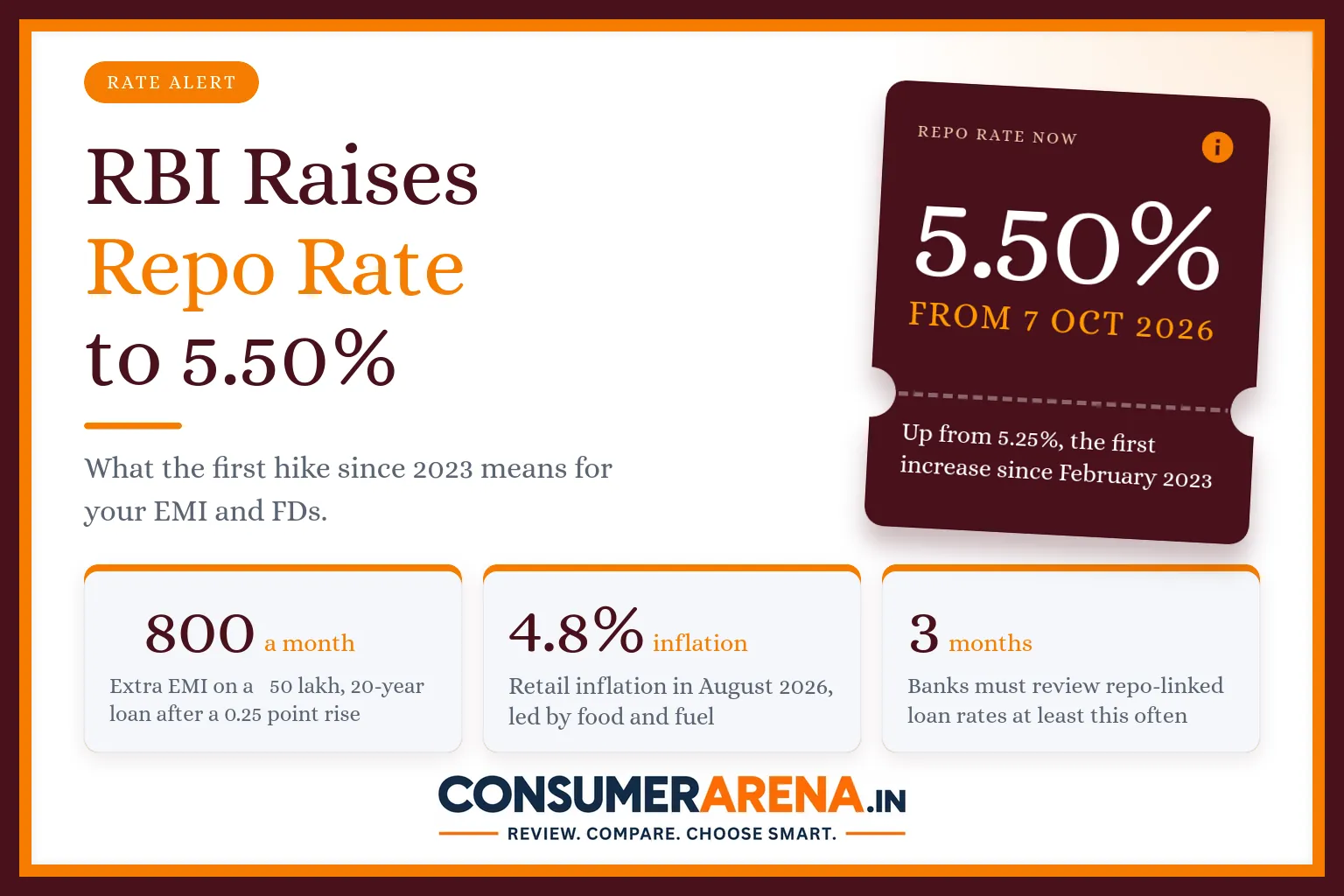
If you pay a home loan EMI every month, you probably stopped thinking about interest rates some time ago. Through 2025 the rate kept coming down, and for most of this year it stayed still. That quiet phase ended on 7 October 2026, when the Reserve Bank of India raised the repo rate by a quarter of a percentage point, from 5.25% to 5.50%. It is the first increase since February 2023, and the RBI has said more could follow.
For borrowers, that means EMIs are about to go up a little. For people who keep money in fixed deposits, it may slowly turn into better returns. Here is what changed, why, and what you can do about it.
What Happened on 7 October 2026?
The repo rate is the interest rate at which the RBI lends money to banks. When it goes up, borrowing becomes costlier for banks, and they pass that on to you through higher loan rates. When it goes down, loans get cheaper. Since 2019, most new floating-rate home loans from banks are linked directly to this rate, so a change in the repo rate reaches your EMI faster than it used to.
At the end of its three-day meeting, the RBI’s rate-setting committee voted unanimously for a 0.25 percentage point increase. Two other rates moved with it: the rate at which banks borrow from the RBI in an emergency went to 5.75%, and the rate banks earn for parking spare money with the RBI stayed at 5.25%. The committee also changed its official position from neutral to what it calls “calibrated tightening”. In plain words, the RBI now expects to hold rates where they are or raise them further, step by step, and has ruled out any cut for the near future.
Why Did the RBI Raise Rates Now?
The short answer is rising prices. Retail inflation climbed to 4.8% in August 2026 from 4.5% in July, pushed up mainly by food and fuel. Sugar and onion prices rose sharply. The RBI now expects inflation to average 5.2% for the financial year, with the October to December quarter touching 6%, which is the upper edge of the band the RBI is supposed to keep it within.
Behind the food and fuel numbers sit bigger worries: fresh tension in West Asia in September that pushed crude oil prices around, a weaker rupee that makes imports costlier, and a patchy monsoon that could hurt the coming winter crop. At the same time, the economy is growing well, with the RBI expecting 7.1% growth this year. When growth is strong and prices are rising, a central bank typically raises rates to cool demand before inflation gets out of hand.
How It Affects Your Home Loan EMI
If your home loan is a floating-rate loan from a bank, taken in or after October 2019, it is almost certainly linked to the repo rate. Your bank must review the rate at least once every three months, so you should see the new rate on your next reset date. Some banks pass on the change within days; others wait for the scheduled reset. Your bank will usually send an SMS or email when the rate changes.
How much does 0.25 percentage point matter? Take a ₹50 lakh loan with 20 years left, moving from 8.5% to 8.75%. The EMI rises from about ₹43,400 to about ₹44,200, roughly ₹800 more a month, or about ₹1.9 lakh extra over the remaining life of the loan if nothing else changes. On a ₹30 lakh loan with 15 years left, moving from 9% to 9.25%, the EMI goes up by around ₹450 a month. These are illustrations; your own figure depends on your loan amount, rate and remaining tenure.
Many banks do not raise the EMI at all. Instead they quietly extend the tenure, so you pay the same amount each month for a few more months at the end. This feels painless, but it costs more in total interest. You are allowed to ask the bank to keep the tenure and increase the EMI instead, and you can also pay a small lump sum to bring the loan back on track.
What about car loans, personal loans and credit cards?
Car loans and personal loans are usually fixed-rate, so an existing loan does not change. New loans, however, will be priced a little higher from now on. Credit card interest is already very high and is not linked to the repo rate, so nothing changes there, but the general message is the same: borrowing is getting slightly more expensive, so this is not the month to roll over a card balance.
What It Means for Fixed Deposits and Savings
Higher policy rates are usually good news for savers, but with a delay. Banks raise deposit rates only when they need more money or when competitors move first, so the increase on fresh FDs may take weeks or months to show up, and it may be smaller than 0.25 percentage point. Existing FDs are not affected either way; the rate you locked in stays until maturity.
Savings account interest rarely moves with the repo rate. If you have money sitting idle in a savings account, the gap between what it earns and what a fixed deposit pays is likely to widen over the coming months.
What You Should Know Before Reacting
- This is one small step, not a shock. A 0.25 percentage point increase takes rates back to where they were earlier in 2026, before the last cut.
- The RBI has said the next move can only be a hold or another hike. Plan for EMIs to stay at the higher level for a while rather than hoping for a quick reversal.
- The direction of future hikes depends on inflation, so food and fuel prices over the next few months will decide what happens at the December review.
- Rate changes are not a reason to rush into a new loan or to break an existing FD. Think about your own needs first.
What You Can Do Right Now
- Check which benchmark your home loan uses. Your loan statement or the bank’s app will say “repo linked” or “EBLR” for a repo-linked loan, and “MCLR” for an older type that moves more slowly. Loans from housing finance companies follow their own internal rate.
- Find your next reset date and watch for the bank’s message. If you do not get one within a month, call the branch and ask what your new rate is.
- Ask the bank how it is applying the change: higher EMI or longer tenure. If you can afford it, keep the tenure and let the EMI rise; it saves interest.
- If you have a bonus or spare savings, consider a part-prepayment. Even a small lump sum early in the loan cuts a lot of future interest, and banks cannot charge a penalty for prepaying a floating-rate home loan.
- Compare your rate with what your bank offers new customers. If the gap is large, you can ask for a conversion to the lower rate for a small fee, or move the loan to another lender.
- If you were planning a fixed deposit, there is no harm in waiting a few weeks to see whether your bank raises FD rates, or splitting the money into two deposits so part of it can be booked later at a better rate.
A quarter-point change will not upset most household budgets, but it is a signal. The cheap-money phase of 2025 is over for now, and borrowing costs are drifting up. Knowing how your loan is priced, and keeping the tenure under control, is the simplest way to stay ahead of it.
Frequently Asked Questions
What is the new repo rate after the RBI decision on 7 October 2026?
The RBI raised the repo rate by 0.25 percentage point, from 5.25% to 5.50%. The decision was unanimous and the RBI changed its stance to “calibrated tightening”, which means it does not plan to cut rates in the near future.
Will my home loan EMI increase immediately?
Not on the same day. If your loan is repo-linked, the bank must review your rate at least once every three months, so the change reaches you on your next reset date. Some banks pass it on within days, others take longer. Your bank should inform you by SMS or email.
How much more will I pay on a ₹50 lakh home loan?
As an example, on a ₹50 lakh loan with 20 years left, a rise from 8.5% to 8.75% pushes the EMI up by roughly ₹800 a month, or about ₹1.9 lakh over the rest of the loan. Your actual figure depends on your rate, balance and remaining tenure.
Should I keep the same EMI and let the tenure increase?
Letting the tenure stretch keeps your monthly outgo the same but costs more in total interest. If your budget allows, ask the bank to keep the tenure and raise the EMI instead, or make a small part-prepayment. There is no penalty for prepaying a floating-rate home loan.
Will fixed deposit rates go up now?
Possibly, but with a delay and not always by the full amount. Banks raise FD rates when they need funds or when rivals do. Existing deposits are not affected; the rate you locked in stays until maturity.
Why did the RBI raise rates when it was cutting them last year?
Retail inflation rose to 4.8% in August 2026, led by food and fuel, and the RBI expects it to climb to around 6% in the October to December quarter. With the economy growing at about 7%, the RBI chose to raise rates early to keep prices in check.
Related articles
 Financial educationUPI Payment Failed but Money Deducted? Refund Time, Compensation and What to Do10 Oct 2026
 Financial educationHealth Insurance Claim Rejected? What to Do Next, Step by Step10 Oct 2026
 Financial educationSBI ATM Charges From 1 October 2026: Free Limit Cut for Salary and Basic Savings Accounts12 Oct 2026
 Financial educationNew NPS Charges From 1 October 2026: What the ₹200 Fee and 0.20% Yearly Charge Mean for You13 Oct 2026