







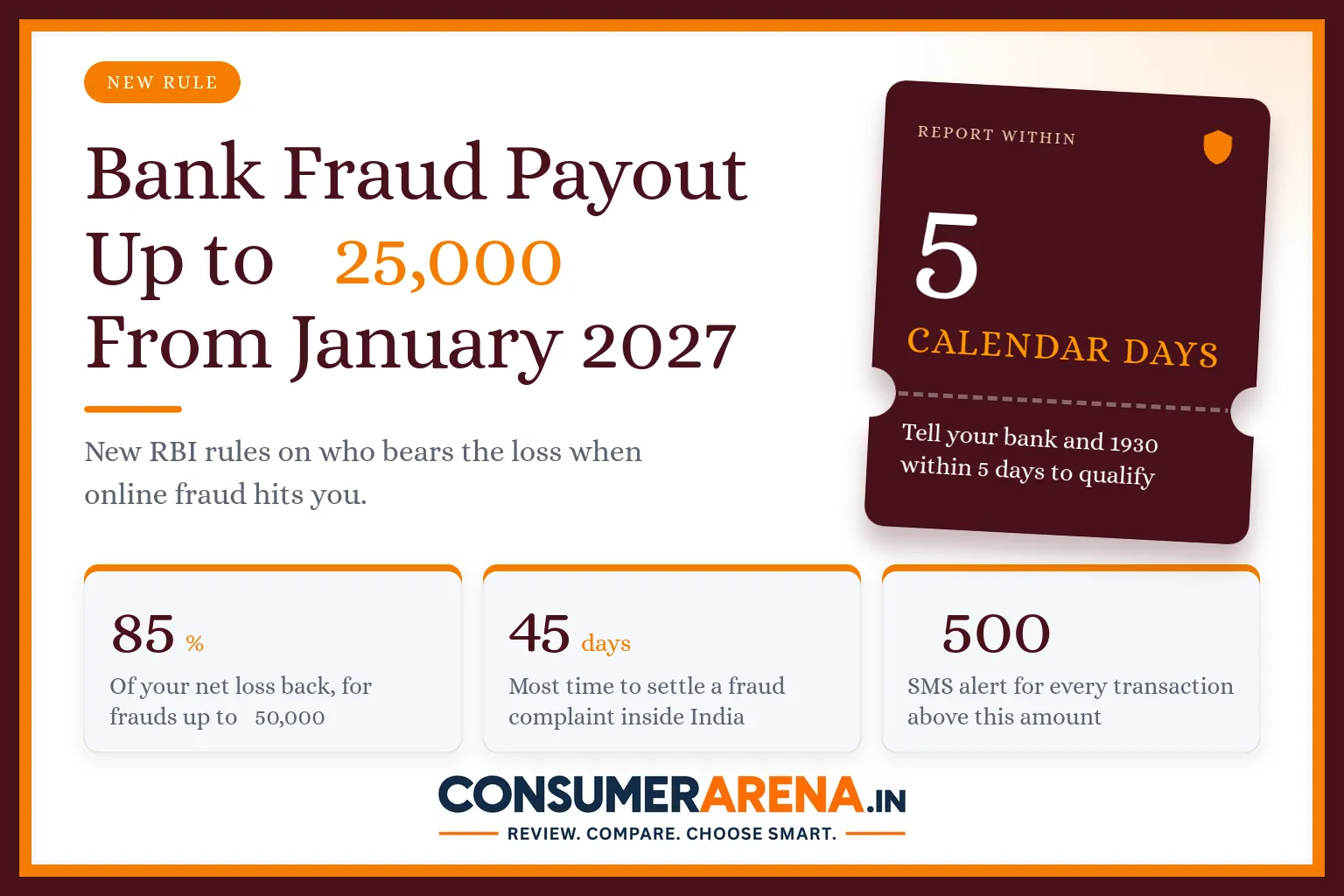
Losing money to an online fraud is painful, and getting it back from the bank has often meant weeks of calls and emails with no clear answer. From 1 January 2027, new RBI fraud compensation rules change that for customers of commercial banks. They spell out when the bank must carry the loss, set a deadline for settling complaints, and add a new payout of up to ₹25,000 for small frauds.
What Is Changing?
The new rules deal with fraudulent electronic banking transactions. In plain words, that is money taken from your account through UPI, net banking, cards or any other digital channel without your genuine consent. They apply to transactions made on or after 1 January 2027.
They also reach further than the old rules. Earlier, protection mainly covered transactions you never made at all. Now it also covers payments made with details a fraudster tricked out of you, and payments you approved because someone pressured or threatened you.
The rules cover commercial banks. Small finance banks, payments banks, regional rural banks and local area banks are not part of this set of rules, so if your account is with one of them, ask your bank what protection applies to you.
Who Bears the Loss When Fraud Happens?
This is the part that matters most when something goes wrong. The answer now depends on whose fault the fraud was.
- The bank’s fault: if the fraud happened because of a lapse on the bank’s side, you lose nothing, even if you did not report it. The money must be put back.
- A breach elsewhere: if the fault lies somewhere else in the system, and neither you nor the bank caused it, you lose nothing as long as you report it within five calendar days. A later report is handled under your bank’s own policy.
- Your own carelessness: if the loss happened because of your negligence, you carry the loss until you report the fraud. Anything taken after you report it is the bank’s responsibility. You may still qualify for the new compensation explained below.
One shift is easy to miss but very important. The bank now has to prove that you were careless. It can no longer simply reject your complaint by saying so.
The New Compensation of Up to ₹25,000
If you lose up to ₹50,000 in a fraud, you can get back 85% of your net loss, up to a maximum of ₹25,000. Net loss simply means what you lost minus any money already recovered.
- You lose ₹20,000 and nothing is recovered: you get ₹17,000.
- You lose ₹20,000 and ₹5,000 is recovered: your net loss is ₹15,000, so you get ₹12,750.
- Your net loss is ₹40,000: 85% would be ₹34,000, but the limit means you get ₹25,000.
Who Can Claim It
- Individual customers, including sole proprietors, whose total loss is ₹50,000 or less.
- The loss must be genuine.
- You must report the fraud within five calendar days to both your bank and the cybercrime helpline 1930 (or the website cybercrime.gov.in). Reporting to only one of them is not enough.
- You can claim it only once in your lifetime. Joint account holders also get just one claim across their joint and individual accounts.
Once your bank receives your application, it must pay within five calendar days. Most of the money comes from the RBI, with the banks covering the rest. If money is recovered from the fraudster later, it is shared between you, the RBI and the banks.
Keep one limit in mind: the compensation scheme runs for one year and covers frauds that happen within a year of 1 January 2027. Nothing has been announced yet about what happens after that.
Faster Complaints and Other Protections
- Report any time: banks must let you report fraud 24 hours a day, 7 days a week, through more than one channel, and give you a complaint number straight away.
- A clear deadline: a complaint must be settled within 45 calendar days for fraud inside India and 60 days for fraud from abroad.
- No extra cost: money put back is dated to the day of the original transaction, with no added interest or charges.
- Credit card fraud: the bank must put the disputed amount back on your card within five calendar days of your complaint. You cannot spend it until the case is settled, but you are not charged interest on it.
- More alerts: you must get an SMS for every transaction above ₹500, and an email for every transaction if you have given your email address. Banks cannot charge you for these alert messages.
These alerts matter. The faster you spot a debit you do not recognise, the more likely you are to report it inside the five-day window.
What You Can Do Right Now
The rules start in January, but a few small steps today will make sure you can use them.
- Update your mobile number and email with your bank. Alerts are your early warning, and you only get them if your details are correct.
- Save the numbers you will need. Keep 1930 and your bank’s official fraud number (from its website, card or passbook) in your phone.
- Read every debit alert. If you do not recognise a payment, act the same day.
- Report to both places. Call your bank and 1930, or use cybercrime.gov.in, and note down both complaint numbers.
- Keep the evidence. Save screenshots, SMS messages, call details and any chats with the fraudster.
- Stay careful. The payout is capped and can be used only once, so never share your OTP, PIN or passwords with anyone.
Remember that frauds before 1 January 2027 are still handled under the existing rules. If you lose money before then, report it quickly to your bank and to 1930 all the same.
Frequently Asked Questions
When do the new RBI fraud compensation rules start?
They apply to electronic banking transactions made on or after 1 January 2027. The ₹25,000 compensation scheme runs for one year and covers frauds that happen within a year of that date.
How much compensation can I get if I lose money in an online fraud?
If your total loss is ₹50,000 or less, you can get 85% of your net loss, up to ₹25,000. For example, a ₹20,000 loss with nothing recovered brings back ₹17,000.
How quickly do I need to report a fraud?
Report it within five calendar days to both your bank and the cybercrime helpline 1930 or cybercrime.gov.in. Reporting to only one of them, or reporting late, can cost you the compensation.
Can I claim the compensation more than once?
No. It can be claimed only once in a lifetime. Joint account holders also get just one claim across their joint and individual accounts.
What if the fraud happened because of the bank’s mistake?
Then you bear no loss at all, even if you did not report it, and the bank must put the money back. The bank also has to prove carelessness on your part before it can make you bear any loss.
Do these rules cover every bank?
They cover commercial banks. Small finance banks, payments banks, regional rural banks and local area banks are not part of this set of rules, so check with your bank if your account is with one of them.
Related articles
 Financial educationNew NPS Charges From 1 October 2026: What the ₹200 Fee and 0.20% Yearly Charge Mean for You13 Oct 2026
 Financial educationSBI ATM Charges From 1 October 2026: Free Limit Cut for Salary and Basic Savings Accounts12 Oct 2026
 Financial educationEPF Wage Ceiling Raised to ₹25,000: What It Means for Your Salary, PF and Pension16 Oct 2026
 Financial educationATM Debited Money but No Cash? Refund Deadline, ₹100 a Day Compensation and What to Do17 Oct 2026