

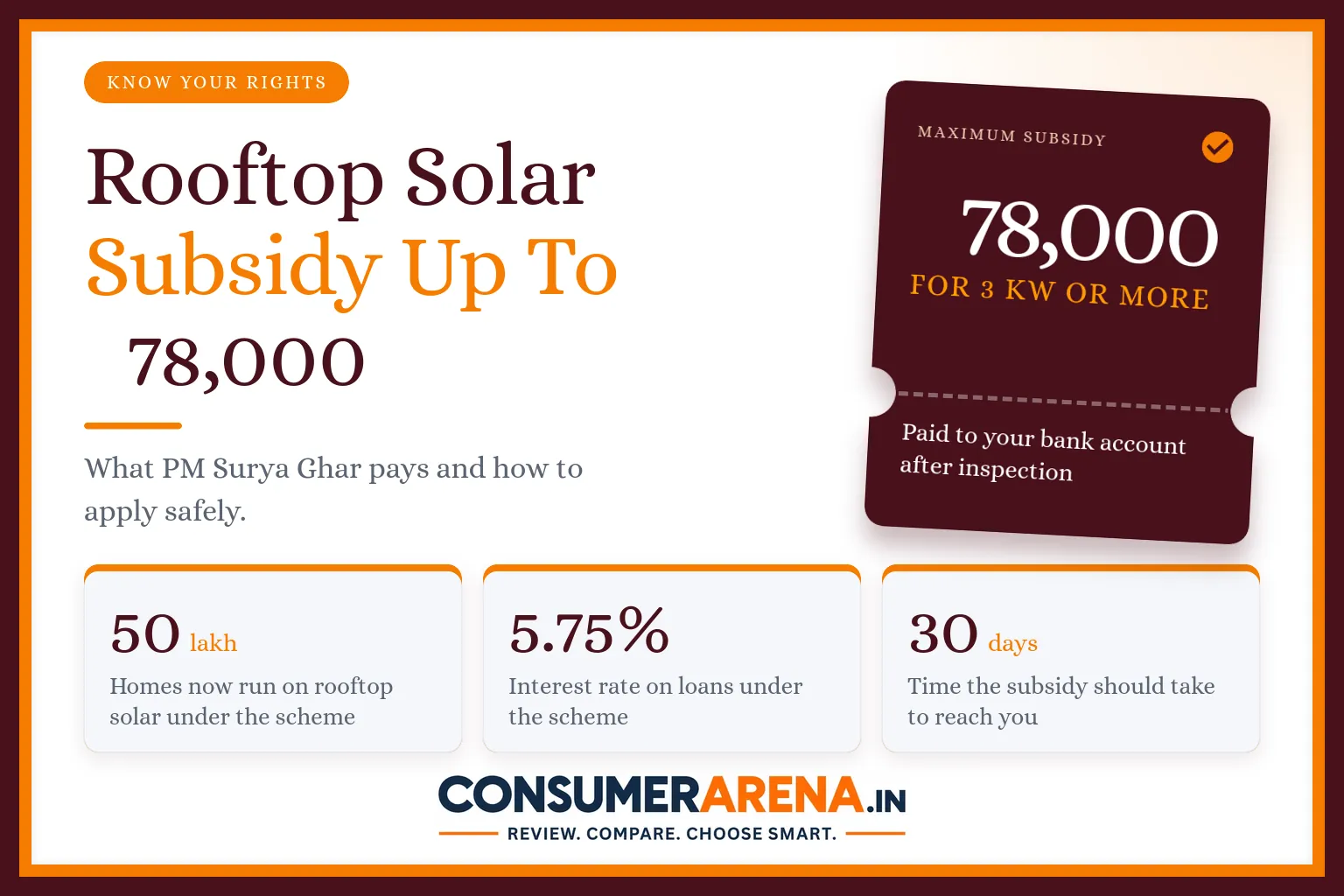
If your electricity bill keeps climbing, rooftop solar may already have crossed your mind. You are not alone. Around 50 lakh Indian homes now run on rooftop solar under the PM Surya Ghar scheme, and the government pays part of the cost directly into your bank account. Here is what you can claim, what it really costs, and how to apply without getting trapped by an over-eager installer.
What Is PM Surya Ghar?
PM Surya Ghar: Muft Bijli Yojana is a government scheme that helps ordinary households put solar panels on their roofs. It started in February 2024. The idea is simple: the panels make power during the day, you use it at home, and your power bill shrinks. Whatever you do not use can go back to the grid.
The pace has picked up fast. Daily installations rose from about 5,000 in October 2025 to about 16,000 in July 2026, and July alone saw a record 5.06 lakh installations. About 19 lakh households now report a zero electricity bill.
How Much Subsidy Can You Get?
The central subsidy depends on the size of the system you install:
- 1 kW system: ₹30,000
- 2 kW system: ₹60,000
- 3 kW or bigger system: ₹78,000 (the maximum)
In simple terms, you get ₹30,000 for each of the first two kilowatts and ₹18,000 for the third. Anything above 3 kW gets no extra central subsidy. Some states add their own incentive on top, so ask your electricity company what your state offers.
What Will It Really Cost You?
A typical 3 kW home system often costs somewhere between ₹1.5 lakh and ₹2 lakh, depending on the panels, the inverter and the installer. After the ₹78,000 subsidy, you pay the rest. Prices vary, so take quotes from more than one registered installer before you decide.
If you do not want to pay everything from savings, the scheme also offers loans at 5.75% interest. So far, loans have been approved for about 21.87 lakh applicants.
Will It Cut Your Bill?
For many homes, yes, and sometimes by a lot. The scheme suits households that use roughly 150 to 300 units a month. A smaller home that uses very little power will save less, so look at your last few bills before you pick a size.
You can also earn a little. In 2024-25, more than 12 lakh households sold extra power back to the grid and earned about ₹3,500 a year on average. Do not count on this as income, though. It depends on how much you use and how much your roof produces.
How to Apply, Step by Step
- Go to the official portal, pmsuryaghar.gov.in, and register. Choose your state and electricity company, then enter your consumer number, mobile number and email.
- Log in and submit your rooftop solar application.
- Wait for approval. For systems up to 10 kW, the approval is now automatic and no feasibility check is needed.
- Pick an installer from the list of registered vendors on the portal. More than 34,000 are registered.
- After installation, upload the plant details and apply for a net meter. This meter records the power you send back to the grid. Most states have removed the fee for it.
- Your electricity company inspects the system and fits the meter. The portal then gives you a commissioning certificate.
- Upload your bank details with a cancelled cheque. The subsidy is meant to reach your account within about 30 days.
Things to Watch Out For
Where money is flowing, middlemen follow. Apply only through the official portal and pick a vendor registered there. Be careful with anyone who asks you to pay a large amount upfront for getting the subsidy approved. The subsidy comes to your bank account only after your system is inspected and commissioned, and you never need to pay anyone to receive it.
Also check the panel brand, the warranty and who will service the system after installation. A cheap quote means little if nobody answers your call two years later.
Frequently Asked Questions
Who can get the PM Surya Ghar subsidy?
The scheme is meant for residential households. Housing societies and resident associations get a separate subsidy for common facilities such as lifts and EV charging. Check the official portal for the full conditions.
What is the maximum subsidy under PM Surya Ghar?
The maximum central subsidy is ₹78,000, which you get for a system of 3 kW or more. Systems bigger than 3 kW do not get any extra central subsidy.
How long does it take to get the subsidy?
The subsidy is meant to be paid into your bank account within about 30 days after your system is inspected and the commissioning certificate is issued. Delays can happen if bank details or documents are incomplete.
Can I take a loan for rooftop solar under this scheme?
Yes. The scheme offers loans at 5.75% interest. Check the terms with your bank before you sign, including how the loan works alongside the subsidy.
Do I have to pay to apply on the portal?
Registering and applying on the official portal is online. Most states have also removed the application and net-meter fees, but check with your electricity company for your state.
Related articles
 EnergyLPG Subsidy and Aadhaar Check: What Every Gas Cylinder User Should Do Now3 Oct 2026
 EnergyMaharashtra Rooftop Solar Rules 2026: Proposed Changes and What Consumers Should Know27 Sep 2026
 EnergyElectricity Bill Too High? What the Proposed Consumer Rules Say About Billing and New Connections17 Oct 2026
 E-CommerceHow to File a Consumer Complaint in India: From Helpline 1915 to Consumer Court11 Oct 2026