








Most of us keep our money in many places. A savings account here, a fixed deposit there, and shares or mutual funds in a demat account. To see the full picture, you open three apps and add up the numbers yourself. RBI now wants to make that easier, with a plan to bring bank deposit details into one consolidated account statement.
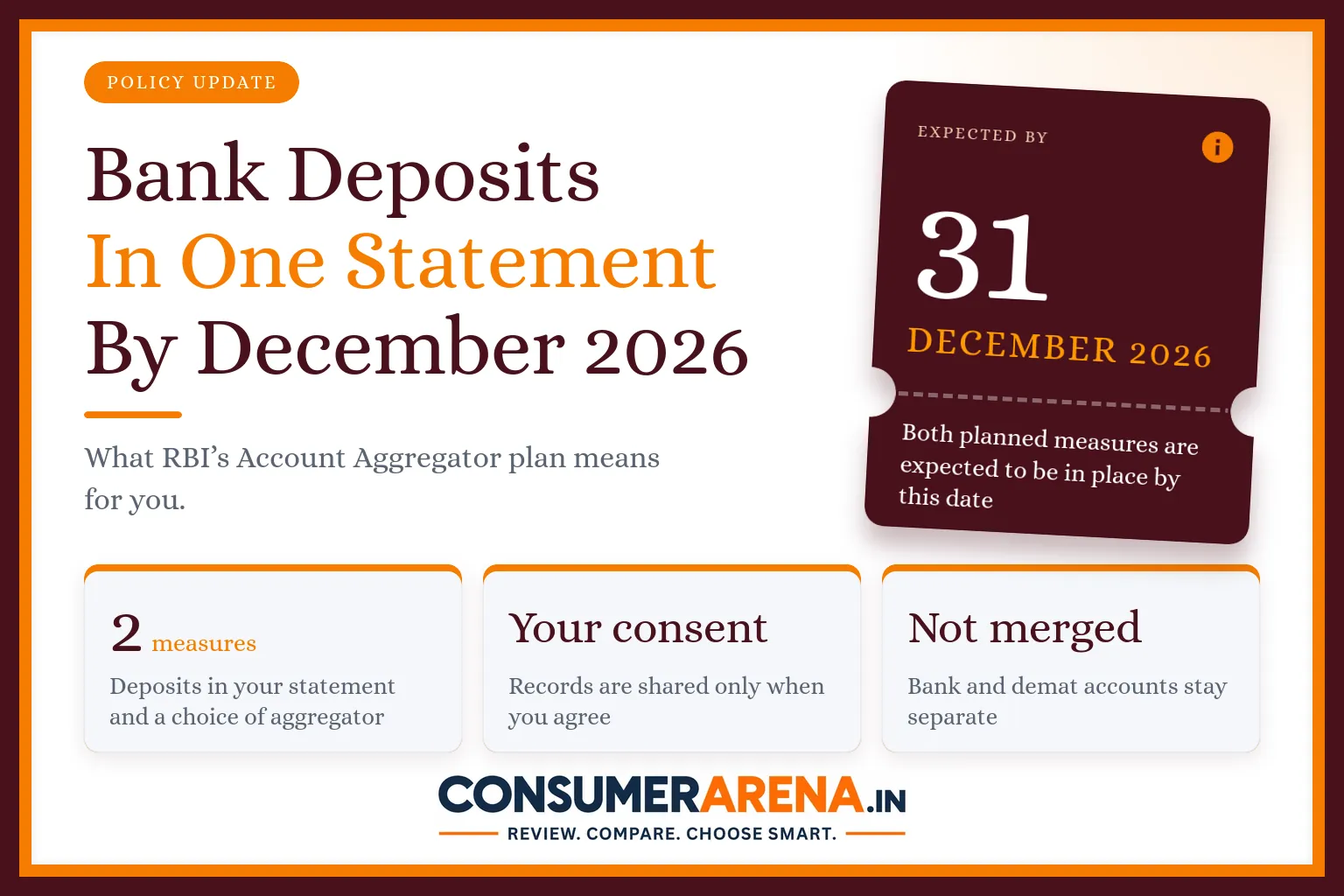
The plan was announced on 7 October 2026, along with the interest rate decision. It is expected to be in place by 31 December 2026. Here is what it means in plain words.
What Has Been Announced?
Two connected changes are planned.
- Deposits in your combined statement. The companies that hold your demat account, called depositories, already send a single statement covering your shares and mutual funds. They will now be able to add your bank deposit accounts to it.
- Choose any account aggregator. An account aggregator is a licensed service that fetches your financial records from banks and other institutions and shares them with someone else, but only after you say yes. The plan is to make these services work with each other, so you can use whichever one you prefer to reach your records held at different institutions.
If you have a demat account, you should be able to see your holdings and your bank deposits in one place. If you do not have a demat account, you can still get a combined view of your financial information and share it through these services.
Why This Matters to You
Today, your information is scattered. Each bank has its own app, each fund house has its own statement, and the demat statement arrives separately. That makes it easy to forget an old fixed deposit or lose track of how much you really hold.
A single statement can help you in everyday situations:
- planning your savings and checking whether you rely too much on one place
- keeping track of fixed deposits that are about to mature
- getting your records together when you apply for a loan
- helping family members find your accounts when they need to, which is often hard today
Will Your Bank and Demat Accounts Be Merged?
No. This is about showing information together, not moving money or combining accounts. Your bank deposit will stay a bank deposit. It will not turn into an investment, and nothing moves between your bank and demat accounts. The statement is only a view.
Who Decides What Is Shared?
You do. The account aggregator system works on your consent. Your records are fetched and passed on only when you agree, and you decide what is shared and with whom. Even so, it is wise to read each consent request before you tap approve. Check which accounts are included, who will receive the data and for how long.
It is also worth knowing what is still unclear. RBI has not said that every bank account will automatically show up in every statement. Which deposit accounts will be included, and exactly how the consent steps will look, will become clearer when banks and depositories start the facility.
What You Can Do Right Now
- Do not expect it today. The facility is expected by 31 December 2026, so it may not be live yet. Watch for messages from your bank or depository.
- Keep your details updated. Check that your mobile number, email and address match across your bank and demat accounts, so your records line up when the facility starts.
- Be careful with calls and links. A new facility is a good excuse for scammers. Nobody needs your OTP, PIN or password to show you a statement. If someone asks for them, it is a fraud.
- Use only trusted apps. When the facility starts, use your bank or depository apps or well-known services, and read every consent screen.
- Make a list of your deposits. Until then, write down your fixed and recurring deposits in one place so nothing is forgotten.
Frequently Asked Questions
What is a consolidated account statement?
It is a single statement that brings together your holdings, such as shares and mutual funds, so you do not have to check several statements. Under the new plan, bank deposit details can also be added to it.
When will bank deposits start showing in it?
The change is expected to be in place by 31 December 2026. The exact start date for you will depend on when your bank and depository switch it on.
Do I need a demat account to use this?
A demat account holder can see holdings and bank deposits in one statement. Without a demat account, you can still get a combined view of your financial information and share it through an account aggregator.
Will my bank and demat accounts be merged?
No. Only the information is shown together. Your accounts stay separate and no money moves between them.
Is my data shared without my permission?
No. The system is built on your consent, and your records are shared only when you agree. Read each request carefully before approving it.
Should I share my OTP or PIN to get the statement?
Never. Genuine services do not ask for your OTP, PIN or password to show you your own statement. Treat any such request as a scam.
Related articles
 Financial educationInsurance Websites and Dark Patterns: What IRDAI Proposes to Change17 Oct 2026
 Financial educationATM Debited Money but No Cash? Refund Deadline, ₹100 a Day Compensation and What to Do17 Oct 2026
 Financial educationEPF Wage Ceiling Raised to ₹25,000: What It Means for Your Salary, PF and Pension16 Oct 2026
 Financial educationRBI Fraud Compensation From 1 January 2027: How You Can Get Up to ₹25,000 Back15 Oct 2026