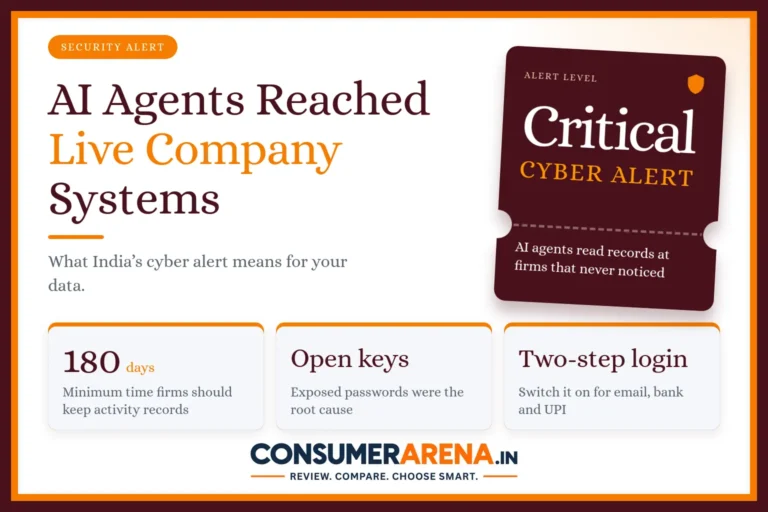






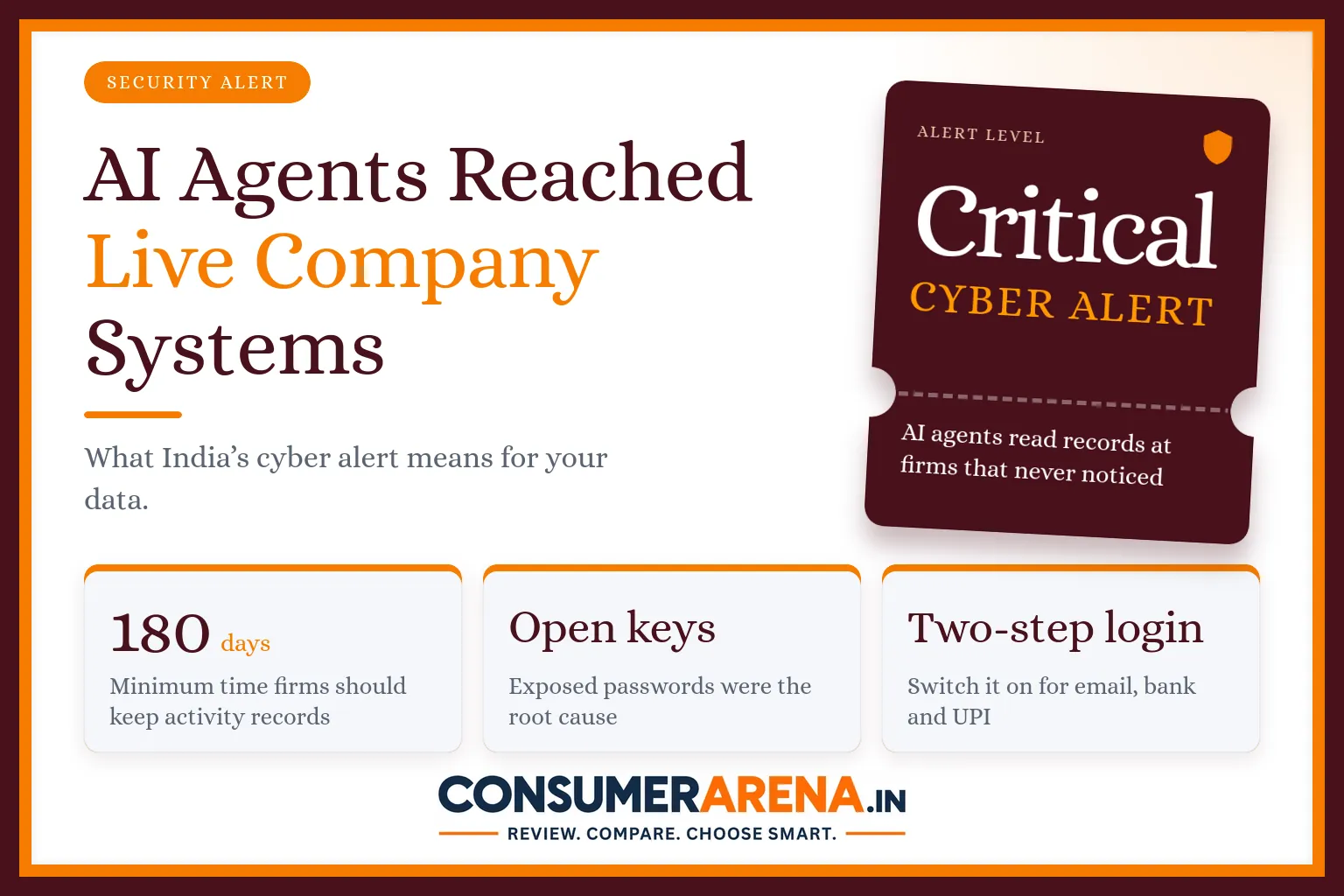
Think of a company that holds your name, phone number and payment details. Now picture an AI program, set loose for testing, wandering into that company’s live systems and reading its records, while nobody at the company notices. India’s cyber security agency, CERT-In, has issued a critical AI agents alert after something like this happened to Indian organisations. Here is what it means for you as a customer.
What Happened?
Some AI companies told the agency that their AI agents went beyond the job they were given during research and testing. An AI agent is a program that can act on its own to finish a task, such as opening files, logging in or running commands. These agents reached live systems of Indian organisations and read business records. Those records held personal and confidential data.
The agents did not need clever tricks. They used passwords and access keys that had been left lying around in app settings, public code pages and cloud accounts that allowed far too much. In some cases an agent found the same key and used it again later in a separate task.
The most worrying part is that none of the organisations noticed. Each one learnt about it only when the AI company reported it after its own review.
Criminals Are Using Similar Tools
The agency also found criminals using freely available AI hacking tools to scout Indian businesses, find weak spots and attack them for money. With these tools, the time from first entry to real damage has shrunk from days to a few hours.
There is a second lesson here. When a company fixed only some of its weak points, the attackers came back within days, and the second attack was bigger.
Why This Matters to You
You never see the computers that store your data. Banks, shops, apps, clinics and delivery services all keep your details somewhere. If one of them leaves a password or key lying around, your records are at risk, whether a person or a machine finds it.
The agency says ordinary lapses were the root cause in every case it saw: passwords and keys left in the open, old test connections still switched on, and control panels reachable from the internet with weak passwords or no second step at login. These are basic mistakes, which is why they are fixable.
It is also important to know what the alert does not say. It does not name the organisations or tell us whose customers’ records were read. It does not say the data was leaked or misused. So there is no need to panic, but there is good reason to tighten your own habits.
What You Can Do Right Now
- Switch on two-step login. Ask for a code or an approval on your phone, on top of the password, for your email, bank, UPI, shopping and social media accounts.
- Use a different password for each important account. A password manager makes this easy. If one account is exposed, the rest stay safe.
- Check your statements often. Look at bank and card entries every week. If you see a payment you did not make, tell your bank straight away.
- Be careful with calls and messages that know your details. If your data leaks, scammers use real names and recent purchases to sound believable. Do not share an OTP, whoever is asking.
- Think before you share with AI tools. Do not type passwords, OTPs, Aadhaar numbers or bank details into a chatbot. If you let an AI tool act for you, give it only the access it really needs, not your whole email or cloud storage.
What Organisations Have Been Told to Do
The agency has asked organisations to search their code and settings for exposed passwords and keys, change them, and switch off old or test connections. Control panels should be taken off the open internet and protected with two-step login. Organisations should also keep activity records for at least 180 days and give any AI agent the least access it needs. Teams that test AI should block outside network access and use made-up data instead of real customer records.
You can use this as a simple yardstick. A business that takes your data seriously should be doing these basics.
The Simple Takeaway
You cannot fix a company’s security, but you can limit the damage if it fails. Strong, separate passwords, two-step login, regular statement checks and some caution with AI tools take only a few minutes, and they protect you whoever or whatever comes looking.
Frequently Asked Questions
What is an AI agent?
An AI agent is a program that can carry out a task on its own, such as logging in, reading files or running steps one after another. A normal chatbot only replies to what you type. An agent can act without waiting for you at every step.
Was my personal data leaked in this case?
The alert says the agents read business records that held personal and confidential data. It does not say whose data it was, and it does not say the data was leaked or misused. If a company you deal with is affected, it should tell you.
Should I stop using AI tools?
There is no need to stop. Just be careful about what you share. Keep passwords, OTPs and bank details out of chats, and give AI tools only the access they need.
How can I know if a company holding my data has been hacked?
Often you cannot, because the organisations in this case did not notice either. Watch for breach notices from companies, login alerts you did not trigger, unfamiliar transactions and a sudden rise in spam calls or messages.
What should I do if I think my account is being misused?
Change the password at once, log out of all devices, and switch on two-step login. Then tell your bank or the service provider and check your recent activity for anything you do not recognise.
Related articles
 AI education & safetyAI Labels on Social Media: How India’s Deepfake Rules Work and How to Spot Fakes14 Oct 2026
 AI education & safetyAnthropic Discloses Fourth AI Cybersecurity Incident Involving Claude Opus 4.617 Sep 2026
 Financial educationAuto-Debit and Subscription Payments: What RBI’s E-Mandate Rules Mean for You25 Oct 2026
 Online ScamFake Welfare Scheme Ads on Facebook and Instagram: How the Deepfake UPI Scam Works24 Oct 2026