














You are planning a trip, or a channel of your own, and you want a camera that goes beyond your phone. The choice usually comes down to a small, tough action camera or a more capable mirrorless camera. Deciding between an action camera or mirrorless camera is easier once you are clear about where you will shoot and how much you want to carry.
What does each camera do best?
An action camera is small, light and built to be mounted almost anywhere. It has a wide lens that keeps everything in focus, strong stabilisation for moving shots, and a body that can take rain, dust and often water. You switch it on, point it and get usable footage.
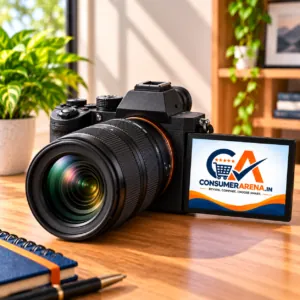
A mirrorless camera is larger and gives you more control. It has a bigger sensor, so it handles dim light and fine detail better. You can change lenses, zoom in on distant subjects and blur a background for a more cinematic look. You pay for this in size, weight and care.
Which one suits travel better?
For travel, the answer depends on the kind of trip. If you spend your days walking, trekking, cycling, snorkelling or riding, an action camera is easier to live with. It fits in a pocket, it does not mind a splash, and you can clip it to a bag strap or a helmet and forget about it.
If your trip is more about sights, food, people and portraits, a mirrorless camera captures far more. You can zoom in on a temple carving across a courtyard, take sharp photos in a dim restaurant, and shoot a portrait with a soft background. These are things an action camera cannot do well.
Many travellers end up wanting both. If you must choose one, pick the camera that matches what you will actually do on most days, not the one you will use on a single adventure day.
Which one suits vlogging better?
Vlogging puts different demands on a camera. You need to see yourself, record clear voice and hold the camera at arm's length for hours.
An action camera is simple to hold, light on the wrist, and keeps you in frame with its wide view. Many have a front screen so you can check your framing. Sound is the weak point: the microphones are small and wind noise is common, so plan to use a separate microphone if your voice is the main content.
A mirrorless camera gives you a flip-out screen on many bodies, better sound options and a sharper face against a blurred background. It is heavier to hold for a long walking vlog, though, and the lens you choose matters. A wide lens suits arm's-length shooting, and a long zoom does not.
What should you compare before you decide?
| What you care about | Action camera | Mirrorless camera |
|---|---|---|
| Size and weight | Very small and light | Larger and heavier |
| Rough weather and water | Built for it | Needs care and covers |
| Low-light quality | Limited | Much better |
| Zoom and lens choice | Fixed wide view | Interchangeable lenses |
| Smooth walking footage | Excellent | Depends on the body and lens |
| Background blur | Very little | Natural and strong |
| Learning effort | Low | Moderate |
Stabilisation matters more than megapixels
When you shoot while walking, riding or running, how steady the footage looks matters more than the number of megapixels. Action cameras are good at this because stabilisation is the main reason they exist. Their wide view also hides small shakes.
On a mirrorless camera, steadiness depends on the body and the lens. Some bodies steady the sensor itself, and some lenses steady the image as well. If you plan to shoot handheld video, check what the body offers for video stabilisation specifically, not just for photos.
Low light and image quality
In bright daylight, the gap between the two is small. Once the light fades, such as at dusk, indoors or in a street market at night, the larger sensor of a mirrorless camera shows clearly. Footage is cleaner, colours are richer and you can recover more detail later.
If you shoot mostly in sunlight outdoors, an action camera gives you good results with far less effort and far less weight.
Common Buying Mistakes
The first mistake is buying the more powerful camera and leaving it at home. A camera you do not want to carry takes no photos, so be honest about your habits.
The second is expecting an action camera to match a mirrorless camera in dim light or portraits. They are made for different jobs.
The third is forgetting the extras. A mirrorless camera needs a lens suited to travel, spare batteries and a bag. An action camera needs mounts, a spare battery and a microphone if sound matters to you.
The fourth is ignoring battery life. Action cameras can run warm and drain quickly when shooting at high quality, so carry spare batteries for a full day out.
Buying Checklist
- Decide whether your trips are active and outdoors, or about sights and people.
- Decide how much weight you are willing to carry all day.
- Check the water and dust protection if you shoot in rain or near water.
- Look for video stabilisation if you shoot while moving.
- Check microphone options if your voice is central to your videos.
Frequently Asked Questions
Is an action camera better than a phone for travel?
It is better in rough conditions, because it is tougher, can be mounted anywhere and stays steady while you move. A phone is easier for casual photos and quick sharing, so many travellers carry both.
Can a mirrorless camera replace an action camera?
Only in part. A mirrorless camera gives better quality in low light and more control, but it is larger and needs care around water and dust. It cannot be clipped to a helmet or taken into a pool as easily.
Which is better for vlogging, an action camera or a mirrorless camera?
An action camera is lighter and keeps you in frame easily. A mirrorless camera gives sharper faces, a blurred background and better sound options. Choose by how much you want to carry and how important image quality is to you.
Do action cameras work well in low light?
They manage in good light but lose quality quickly as it fades. Their small sensors collect less light than the larger sensor of a mirrorless camera.
Do I need a separate microphone for vlogging?
If your voice is the main part of your videos, yes. Built-in microphones on small cameras pick up wind and background noise easily, and an external microphone gives clearer speech.
ConsumerArena Recommendation
Choose an action camera if your travel is active, your weather is unpredictable and you want the lightest kit possible. Choose a mirrorless camera if you care about photo quality, low-light shooting, portraits and the freedom to change lenses, and you are happy to carry a bigger bag.
If vlogging is your main goal, weigh your voice and your face as much as the scenery. A small camera with an external microphone often does more for your videos than a larger camera with poor sound.
And if you can only buy one, pick the one you will take out of the bag on most days. Then look at models in that group that have the stabilisation, protection and battery life your trips need.