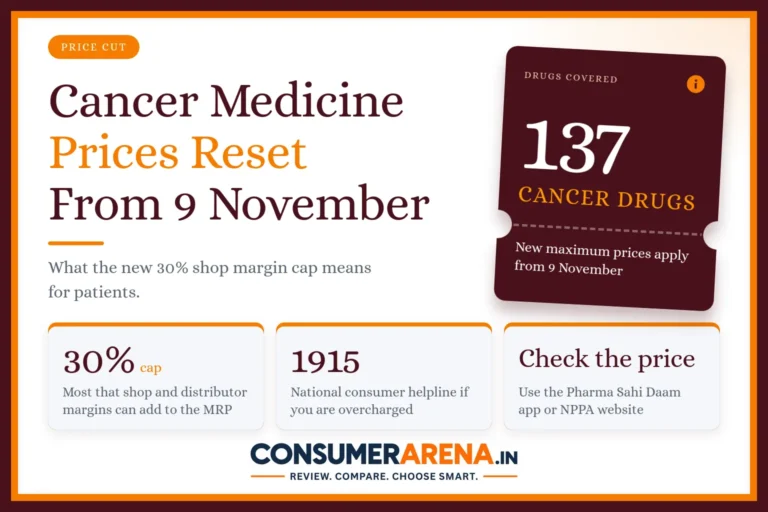







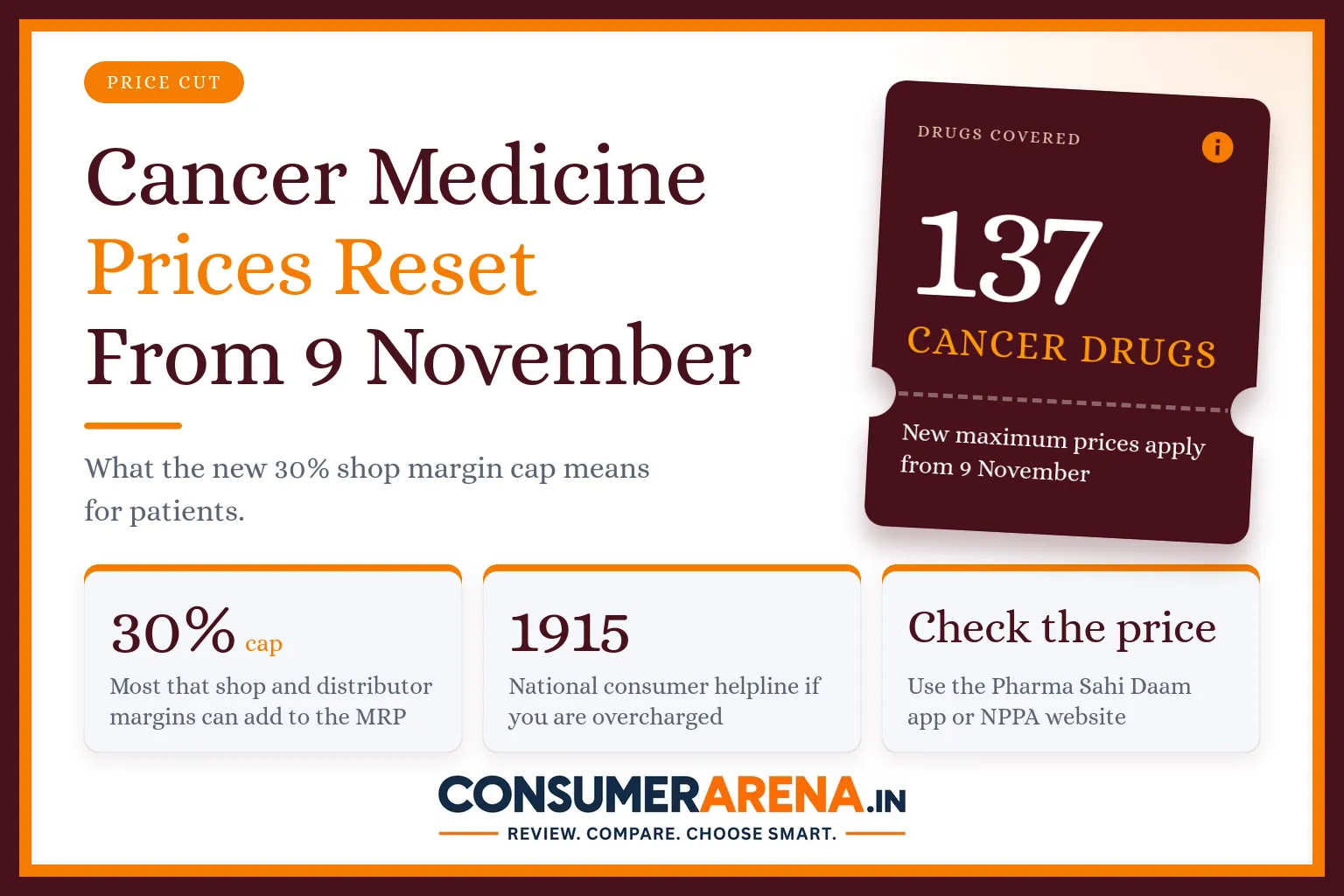
If you or someone at home is buying cancer medicines, the bill is about to change. From 9 November, the price regulator is resetting the maximum retail price (MRP) of 137 anti-cancer drugs, and it has put a hard limit on how much shops and distributors can add on top. Here is what that means in plain terms.
What Has Changed?
The National Pharmaceutical Pricing Authority (NPPA) has capped the trade margin on 137 cancer drugs at 30% of the MRP. The trade margin is the amount added between the price the company sells at and the price printed on the strip or box. It covers what distributors and chemists keep.
The new MRP is worked out from what the manufacturer actually earned per unit in March 2026, leaving out government sales. If a company sold nothing that month, the figures from April 2025 to March 2026 are used instead. The new prices stay in force until the regulator says otherwise, and the list of 137 drugs can be updated from time to time.
Will Every Medicine Get Cheaper?
Not necessarily. Where today’s MRP is higher than the new formula allows, the company has to bring it down. Where today’s MRP is already lower, it stays as it is. So the fall will be different for each brand. A medicine with a thick margin built into its price may drop a lot, while one that is already priced tightly may not change at all.
The order covers every form of a listed drug: tablets, injections and other forms, in any strength, alone or mixed with another drug. It also applies when the same drug is used for a condition other than cancer. Newer products launched after 31 March 2026 are priced by the same formula, and patented medicines are included unless they have been specially exempted.
What Must Companies, Chemists and Hospitals Do?
- Manufacturers must send their revised price lists to the regulator, publish them, and share them with retailers and hospitals.
- Shops and hospitals must charge the revised prices from 9 November and display them where patients can see them. Hospitals must also show the new prices on their websites.
- Manufacturers must keep supplying at their current levels. Cutting average monthly production needs the regulator’s permission, and a company that wants to stop making a medicine must give six months’ notice.
- State drug controllers are responsible for checking that everyone follows the order.
Why This Matters to You
Cancer treatment can run for months, and medicines are often the largest part of the bill. Even a modest cut on each strip adds up over a full course. A clear ceiling on margins also makes it harder for the same medicine to be sold at very different prices from one shop to the next.
There is a caution, too. A lower MRP does not change what a hospital charges for its own services, tests or room. And the order says nothing about the medicines your doctor chooses. Only the doctor can decide what is right for you, so do not switch or skip any medicine just because a price has moved.
What You Can Do Right Now
- Keep the old and new bills side by side for the same medicine. After 9 November the MRP printed on fresh stock should match the revised price.
- Check the official price of a medicine on the Pharma Sahi Daam app or the NPPA website before you pay.
- Ask the chemist or hospital pharmacy for a proper bill that shows the batch, MRP and amount charged.
- If you are charged above the revised MRP, raise it first with the shop or hospital. If that does not work, tell your State Drug Controller’s office. You can also use the national consumer helpline, 1915.
- Remember that old stock may still carry the old MRP printed on the pack. The seller is expected to charge the revised price from 9 November.
Frequently Asked Questions
Frequently Asked Questions
Frequently Asked Questions
When do the new cancer medicine prices start?
The revised prices apply from 9 November. They stay in force until the regulator issues a further order.
How many medicines are covered by the 30% margin cap?
The order covers 137 anti-cancer drugs that are not already under fixed price control. The list may be updated from time to time.
Will my medicine definitely become cheaper?
Not always. If the current MRP is higher than the new formula allows, it must come down. If it is already lower, it stays the same. The change is different for each brand.
How can I check the correct price of a medicine?
You can look it up on the Pharma Sahi Daam app or on the NPPA website. Compare it with the MRP on the pack and the amount on your bill.
Where do I complain if a shop charges more than the revised price?
Start with the shop or hospital pharmacy. If the problem continues, contact your State Drug Controller, which oversees compliance. The consumer helpline 1915 can also guide you.
Related articles
 Online ScamFake Bank and KYC Apps: How the “MR ROBOT” Malware Steals OTPs and What You Should Do30 Oct 2026
 TechnologyPhone Warranty Already Running? Check the Activation Date Before You Pay28 Oct 2026
 Food“100% Whole Wheat” Bread Fined ₹1 Lakh: How to Read Bread Labels Before You Buy27 Oct 2026
 AI education & safetyAI Agents Reached Live Systems of Indian Companies: What CERT-In’s Critical Alert Means for Your Data26 Oct 2026