








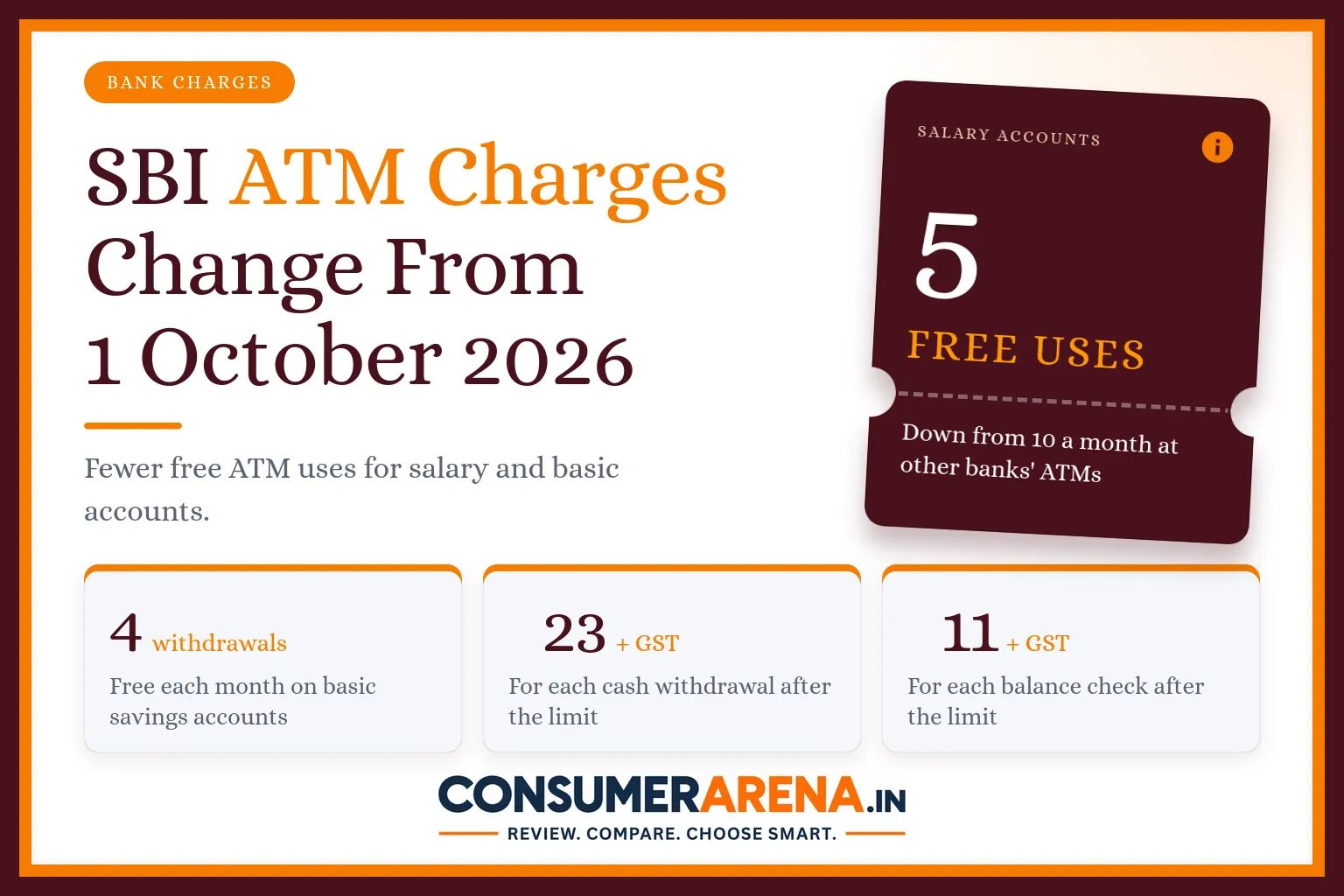
If you take cash out of an SBI account a few times a month, your bank may now charge you for it sooner than before. From 1 October 2026, State Bank of India has cut the free ATM limit for salary package accounts and started charging basic savings account holders after four cash withdrawals. Here is what changed and how you can avoid paying extra.
What Has Changed in SBI ATM Charges?
Two types of SBI accounts are affected, and the changes are different for each.
- Salary package accounts: Free transactions at other banks’ ATMs have come down from 10 to 5 a month.
- Basic Savings Bank Deposit (BSBD) accounts: You get four free cash withdrawals a month. From the fifth one, SBI charges ₹15 plus GST for each withdrawal.
Salary Account Holders: Five Free Transactions at Other Banks
If your salary comes into an SBI salary package account, you now get five free transactions a month at ATMs of other banks. The earlier limit was 10. The rule is the same for every salary package variant and for every city, big or small.
Note that the five free transactions count everything you do at the machine, not just cash withdrawals. A balance check or a mini statement uses up one free transaction, just like a withdrawal does.
After the free limit, you pay ₹23 plus GST for each cash withdrawal and ₹11 plus GST for each balance check or other non-cash service. The per-transaction charges have not gone up. Only the number of free transactions has come down.
SBI’s own ATMs are a separate matter. Salary account holders continue to get 10 free transactions a month there, subject to their account terms. A few special accounts, such as family pension accounts, have their own ATM benefits, so check your account terms if you hold one.
Basic Savings Account Holders: Four Free Cash Withdrawals
Basic savings accounts are often used by people who want a simple account with no minimum balance. These accounts now allow four free cash withdrawals a month. The fifth and every later withdrawal costs ₹15 plus GST.
The count covers cash withdrawals at ATMs, at the bank branch and through Aadhaar-enabled payment services. The basic RuPay debit card still comes with no yearly fee, and receiving money by NEFT or RTGS stays free.
How Much Could You Actually Pay?
Take a salary account holder who uses another bank’s ATM eight times in a month, all for cash. The first five are free. The next three cost ₹23 each, which is ₹69 before GST. It is not a huge amount, but if you use another bank’s machine twice a week, the charges add up over a year.
A basic savings account holder who withdraws cash six times in a month pays for two withdrawals, which is ₹30 plus GST. People who take out small amounts often are hit the hardest, because the charge is the same whether you take out ₹500 or ₹5,000.
How to Avoid Extra Charges
- Withdraw larger amounts less often instead of small amounts again and again.
- Use SBI’s own ATMs when you can, because the free limit there is higher for salary account holders.
- Do not use an ATM just to check your balance. Use the SBI mobile app, SMS banking or the missed-call service instead.
- Pay by UPI or card for everyday shopping, so that you need cash less often.
- Keep a count of your free transactions. Your SMS alerts and mobile app show each ATM transaction.
- Ask your branch whether your account can be changed to a type that suits the way you use it.
Some cardless cash withdrawals, where you take out cash using your phone instead of the debit card, are reported to be outside the new limit for now, “until further notice”. This could change, so check with the bank before you depend on it.
Frequently Asked Questions
When do the new SBI ATM charges start?
The changes apply from 1 October 2026. They cover transactions made from that date.
Does a balance check count as a free transaction?
Yes, for salary package accounts. Both cash and non-cash transactions at other banks’ ATMs count towards the five free ones each month. A balance check beyond the limit costs ₹11 plus GST.
How many free cash withdrawals does a basic savings account get?
Four a month. From the fifth withdrawal, the bank charges ₹15 plus GST each time.
Do I pay for using SBI’s own ATMs?
Salary package account holders get 10 free transactions a month at SBI ATMs, subject to their account terms. Check your account terms for the charge beyond that.
Is GST added on top of the charges?
Yes. The ₹23, ₹11 and ₹15 charges are all quoted before GST, so the amount deducted from your account will be slightly higher.
How can I find out which account type I have?
Check your passbook, the SBI mobile app or ask your home branch. The account type decides which limit applies to you.
Related articles
 Financial educationRBI Raises Repo Rate to 5.50%: What It Means for Your Home Loan EMI and Fixed Deposits12 Oct 2026
 Financial educationUPI Payment Failed but Money Deducted? Refund Time, Compensation and What to Do10 Oct 2026
 Financial educationNew NPS Charges From 1 October 2026: What the ₹200 Fee and 0.20% Yearly Charge Mean for You13 Oct 2026
 Financial educationRBI Fraud Compensation From 1 January 2027: How You Can Get Up to ₹25,000 Back15 Oct 2026