







That monthly OTT charge, the insurance premium and the SIP all leave your account on their own. Since April 2026, the Reserve Bank of India has put the rules for these auto-debit payments into one place, and they give you more control than many people realise. Here is what the auto-debit rules mean for your money.
What Has Changed for Auto-Debit Payments?
An auto-debit, or e-mandate, is the permission you give a company to take money from your account, card or wallet again and again. Think of streaming apps, magazine plans, insurance premiums, mutual fund instalments and credit card bills. The RBI issued a single set of directions on 21 April 2026 that applies from the day it was issued. It covers cards, UPI and prepaid wallets, and payments made in India or abroad.
Most of this was already in force in pieces. What is new is that the rules now sit together, so banks and payment apps work from the same list.
Your Bank Must Warn You Before the Money Goes
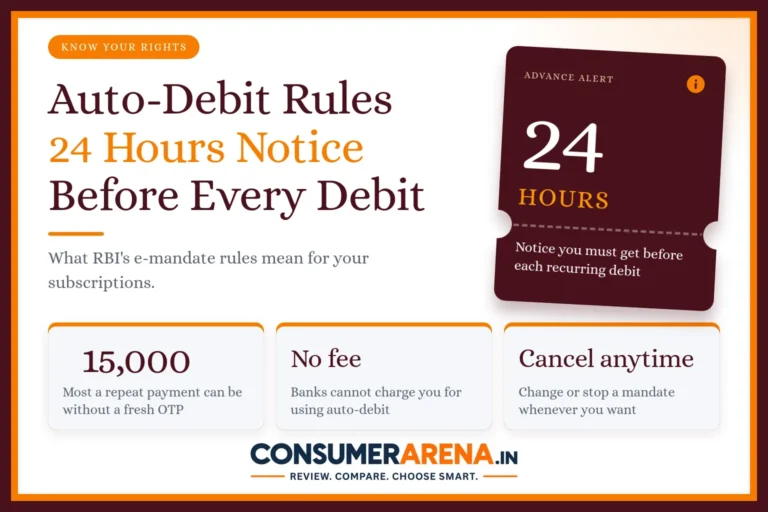
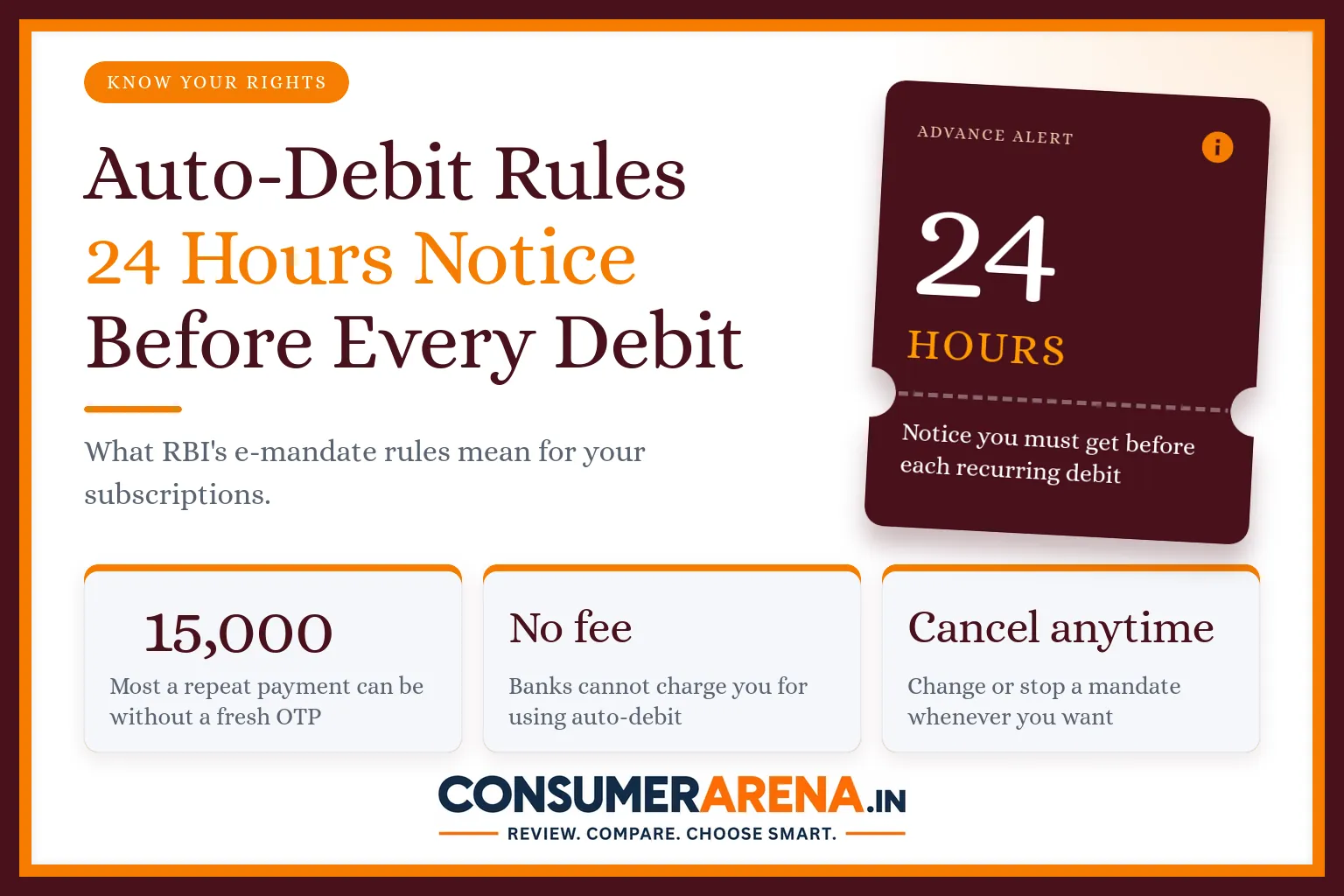
Before every recurring debit, your bank or card company has to tell you at least 24 hours in advance. The alert must carry the name of the company, the amount, the date and time of the debit, a reference number for the mandate and the reason for the charge. That gives you a full day to spot a wrong amount or a plan you meant to cancel.
After the money is taken, you must get a second message with the same details and information on how to complain. One small exception: top-ups that refill a FASTag balance or a National Common Mobility Card do not need the advance alert.
When Will Payments Go Through Without an OTP?
You complete a proper identity check, such as an OTP, when you set up the mandate. After that, repeat payments of up to ₹15,000 each can go through without asking you again. Anything above that needs an extra check every time.
Three kinds of payment get a higher limit of ₹1,00,000 per transaction: insurance premiums, mutual fund subscriptions and credit card bills. If your monthly bill is variable, such as a credit card bill, you can set a maximum amount so the company cannot charge beyond it.
Is There a Fee for Setting Up an Auto-Debit?
No. The rules say customers cannot be charged for using the e-mandate facility. If a bank or app asks you to pay just to register or run a recurring payment, question it and raise a complaint.
How Can You Change or Stop an Auto-Debit?
You can change the validity period or withdraw a mandate at any point of time. You can also skip a single payment without cancelling the whole mandate. Each of these needs a quick identity check, such as an OTP, so nobody else can switch off your payments.
Cancelling inside the company’s own app is not always enough. If a deduction is still coming, check the mandate in your bank, card or UPI app as well.
What You Can Do Right Now
- Open your UPI app, bank app or card app and look at the list of active mandates.
- Cancel any plan you no longer use, such as a free trial that turned paid.
- Check the amount against the last bill, and set a cap on variable payments where the option exists.
- Turn on SMS or email alerts so the 24-hour warning reaches you.
- If the 24-hour alert shows a plan you are unsure about, cancel it before the debit date.
What If Money Is Taken Without Your Permission?
Tell your bank straight away and ask for the dispute process the bank is required to provide. The RBI’s existing limits on customer liability for unauthorised transactions also apply to recurring payments. The sooner you report, the stronger your position, so do not wait for the next statement.
Frequently Asked Questions
Do banks have to send an alert before every auto-debit?
Yes, in nearly every case. Your bank must tell you at least 24 hours before the money is taken. The only exceptions are FASTag top-ups and National Common Mobility Card top-ups, which still get a message after the payment.
Can a company take more than ₹15,000 without my OTP?
Not in most cases. Up to ₹15,000 per payment can go through without a fresh check once the mandate is set up. Insurance premiums, mutual fund subscriptions and credit card bills can go up to ₹1,00,000 per payment.
Will I be charged for setting up an auto-debit?
No. The rules say no charge can be levied on the customer for using the e-mandate facility.
How do I cancel a subscription that is charged automatically?
Withdraw the mandate in your bank, card or UPI app. It needs a quick identity check such as an OTP. Also cancel the plan with the company so it does not try to charge you again.
What should I do if I did not authorise a recurring debit?
Report it to your bank at once and ask for its dispute process. The RBI’s rules on limiting your liability for unauthorised transactions apply to recurring payments too.
Related articles
 Financial educationBank Deposits in One Statement: What RBI’s Account Aggregator Plan Means for You18 Oct 2026
 Financial educationInsurance Websites and Dark Patterns: What IRDAI Proposes to Change17 Oct 2026
 Financial educationATM Debited Money but No Cash? Refund Deadline, ₹100 a Day Compensation and What to Do17 Oct 2026
 Financial educationEPF Wage Ceiling Raised to ₹25,000: What It Means for Your Salary, PF and Pension16 Oct 2026