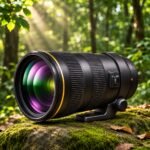














You have a camera body and now you need a lens that suits the way you shoot. The choice of a prime or zoom lens is simple to state and harder to make: a prime lens stays at one focal length, while a zoom lens lets you change how wide or close the view is. The right answer depends on what you photograph, how much you carry and how much light you usually have.
What is the real difference between a prime and a zoom lens?
A prime lens has a fixed focal length. If it is a 50 mm lens, you frame the shot by walking closer or stepping back. A zoom lens covers a range, for example from wide to short telephoto, and you frame the shot by turning a ring or moving a switch.
For you as the buyer, the difference shows up in four places: image quality for the money, low-light ability, size and weight, and how quickly you can adapt when the scene changes. Primes usually do better on the first three. Zooms win clearly on the fourth.
The lens name tells you which one you are looking at. A single number such as 35 mm means a prime. Two numbers such as 24-70 mm mean a zoom. The aperture figure, such as f/1.8 on a prime or f/2.8 on a zoom, tells you how much light the lens collects. A smaller number means more light.
When does a prime lens make more sense?
A prime is the better buy when you shoot in dim rooms, at evening events or indoors without a flash. Primes usually open to a wider aperture than zooms at a similar price, so they let in more light. That lets you keep the shutter speed fast and the picture sharp without pushing the camera into noisy settings.
Primes also give you softer, more pleasing blurred backgrounds in portraits, because the wide aperture separates the person from what is behind them. If portraits, street photography or food photos are your main interest, a prime is often the most useful lens you can own.
Size matters too. A prime is usually lighter and smaller, so the camera stays comfortable to carry through a day of walking or travel. Many people also find that a fixed view makes them think harder about composition, and that improves their photos over time.
The cost of all this is flexibility. If a subject is too far away or too close, you have to move your feet, and sometimes that is not possible, as at a stage, a sports ground or a wildlife spot.
When does a zoom lens make more sense?
A zoom is the better buy when you cannot control where you stand or when the scene changes quickly. Weddings, school functions, family trips, sports and wildlife all reward the ability to reframe in a second without swapping lenses.
A zoom also saves money and space when you are starting out. One lens can replace three or four primes, which matters if you are building a kit on a budget or travelling light with a single lens on the body. Changing lenses in dusty or damp places also exposes the camera to dirt, so one zoom on the body is easier on the camera.
The trade-offs are that zooms are usually heavier and that budget zooms open to a narrower aperture, so they struggle more in low light. A zoom that keeps a wide aperture across its whole range exists, but it is larger, heavier and costs noticeably more. Some zooms have a variable aperture, which means the maximum opening shrinks as you zoom in.
Which focal lengths are worth knowing?
Wide lenses, roughly 35 mm and below on a full-frame camera, suit rooms, landscapes, buildings and group photos. Standard lenses, roughly 35 to 70 mm, show a scene close to what your eyes see and suit everyday photography. Telephoto lenses, roughly 70 mm and above, bring distant subjects closer and suit portraits from a distance, sports and wildlife.
On cameras with smaller sensors, the same lens frames a tighter view, so check the equivalent figure the maker gives before you decide.
Which one suits your kind of photography?
Use this table as a quick starting point, then read the rest of the section that matches your main interest.
| Your main need | Better choice | Why |
|---|---|---|
| Portraits | Prime | Wide aperture and soft background |
| Street and everyday | Prime | Small, light and quick to raise |
| Indoors and low light | Prime | Lets in more light |
| Travel with one lens | Zoom | Covers many scenes |
| Family events | Zoom | Reframe without moving |
| Sports and wildlife | Telephoto zoom | Reach without walking closer |
| Video | Zoom | Smooth, flexible framing |
Does a prime lens really give better photos?
Not automatically. A good zoom from a respected maker can be sharper than a cheap prime. What a prime offers is more image quality for the money you spend, because the design is simpler. On a limited budget, a modest prime often beats a modest zoom in sharpness and low-light performance. At the top end the gap is small, and the choice comes down to convenience.
How should you divide your budget?
Entry-level buyers do well with the zoom that comes with the camera, plus one affordable prime for portraits and low light. This pairing covers most situations and shows you which focal length you actually use. Mid-range buyers can move up to a better zoom with a wider aperture, or add a second prime. Premium buyers who earn from their photos usually carry both: a fast zoom for work that cannot be repeated and primes for the shots where quality matters most.
Before you spend, look at the focal lengths of your best photos. Many cameras record the focal length in each photo’s details. If most of your favourite shots sit at one or two lengths, a prime at that length is a safe buy. If they are spread widely, a zoom suits you better.
Common Buying Mistakes
- Buying a prime and then wishing it could zoom. Decide first whether you are happy to move your feet.
- Choosing a zoom only for its long range. Very long zooms often give up sharpness and low-light ability.
- Ignoring the lens mount. A lens fits only cameras with the matching mount, and adapters often reduce autofocus speed.
- Forgetting the sensor size. On a smaller sensor a lens frames a tighter view than the number suggests.
- Buying several primes at once. Start with one, use it for a month and then decide what is missing.
Buying Checklist
- Which two or three subjects do you shoot most?
- Do you often shoot indoors or after sunset?
- How far can you move to frame a shot?
- How much weight are you happy to carry all day?
- Does the lens mount match your camera?
- Does your camera body already steady the image, or do you need that in the lens?
Frequently Asked Questions
Is a prime lens better than a zoom lens?
Neither is better in every situation. A prime lets in more light and usually gives better quality for the money, while a zoom gives you flexibility. Choose by how you shoot.
Which lens should a beginner buy first?
A versatile zoom, often the one sold with the camera, helps you learn which focal lengths you enjoy. Add a prime later for portraits and low-light shots.
Are prime lenses good for video?
They are, especially if you like a soft background, but you must move the camera to change the framing. For handheld or event video, a zoom is easier to use.
Why is a prime with a wide aperture often cheaper than a zoom with the same aperture?
A prime has a simpler build with fewer moving parts. A wide aperture is therefore usually cheaper to achieve than in a zoom of the same quality.
Does a zoom lens lose quality when I zoom in?
Many zooms are sharpest in the middle of their range and a little softer at the extremes. Some also let in less light as you zoom in. On good lenses the difference is small.
ConsumerArena Recommendation
If you can buy only one lens and you shoot many different things, choose a zoom with a range that covers your most used focal lengths. If you mainly shoot people, food, streets or low-light scenes, choose a prime and enjoy the quality and light it brings. Many photographers end up with both, a zoom for flexibility and a prime for the shots they care about most. Start with the one that solves your biggest frustration today.